Tuesday, May 11, 2010
In July last year I posted about The Manhattan Airport Foundation's absurd proposal to transform Central Park into an airport. Well, that's got nothing on William Zeckendorf's dream airport for New York City, published in the March 18, 1946 issue of Life Magazine.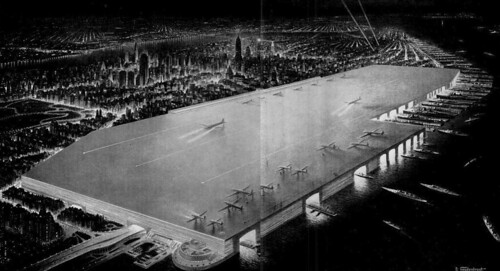
According to the magazine's text (found at Ptak Science Books where I discovered this gem), the airport would have covered 144 city blocks from 24th to 71st Streets and from Ninth Avenue to the Hudson River. (The view above is looking south.) That's approximately 990 acres 200-feet above the streets of Manhattan.
To quote Life, Zeckendorf thinks the $3 billion price tag "can be paid off by rental income within 55 years after the project is completed." Further, and quite optimistically, "although the Manhattan terminal is still in the drawing-board stage and has not yet had approval of New York officials, the planners expect that the increasing tide of air travel will make their idea a necessity." Considering I didn't notice an airport over my head the last time I walked west of Ninth Avenue in Hell's Kitchen, it looks like it wasn't as necessary as the planners imagined.
A handful of theatrical performances this Spring, all in New York City, incorporate architecture in various ways, be it thematic or set design. Below are some details on this synchronistic phenomenon.
Architecture of Dance
For the New York City Ballet's New Choreography and Music Festival, Santiago Calatrava has designed five sets for what's being called Architecture of Dance, showing now at Lincoln Center until June 27. Calatrava seems like a wise choice for this undertaking, given the inspiration he finds in the human body, the kineticism of some of his projects, and of course his name. The circles above, for example, move and overlap to activate the scenography and give the dancers something to respond to. Check out the video on the AOD mini-site for shots of this movement and explanation by Calatrava. The festival also commemorates the 50th anniversary of Lincoln Center.
Attila
For the Metropolitan Opera's recent production of Attila, Jacques Herzog & Pierre de Meuron created the sets and Miuccia Prada designed the costumes. The 19th-century play composed by Verdi "tells the story of civilization’s encounter with barbarism" across a backdrop of "destruction, rubble, lagoon, forest, darkness" rendered "all in a very naturalistic way" by the Swiss architects. The Architects Newspaper's blog has some photos of the floating rubble and vegetation.
The Bilbao Effect
The Bilbao Effect is the second part of a planned trilogy on contemporary architecture by Oren Safdie, the son of well-known architect Moshe Safdie. The younger's first play in the trilogy was 2003's Private Jokes, Public Places, which focused on gender roles in architecture and was set during an architecture student's project critique. The Bilbao Effect, opening for previews on March 12 at the Center for Architecture, "puts contemporary architecture on trial" after an architect's redevelopment project on Staten Island supposedly leads to a woman's suicide. Frank Gehry's presence in the Atlantic Yards project in Brooklyn is clearly a precedent for the play, especially since his Guggenheim in Spain led to the term of the play's title. The show runs until June 5.
The Glass House
The Glass House by June Finfer (directed by Evan Bergman) uses the Farnsworth House by Mies van der Rohe and Philip Johnson's Glass House as backgrounds for "the penetrating dramatic plot that entwines the epic conflict between artist and patron." Further, "Resonance Ensemble is presenting the play is in repertory with Ibsen's The Master Builder."
Theatre for One
Theatre For One from Theatre For One on Vimeo.
"Theatre for One is a portable performing arts space for one performer and one audience member, that turns public events into private acts, making each performance a singularly intimate exchange." Conceived by Christine Jones and designed by LOT-EK, the object will be in Times Square's Duffy Square for ten days, from May 14-23.
Theatre for One resembles a reconfigured "road box" used for theater and other productions. This is certainly in keeping with LOT-EK's preference for reusing prefab and modular constructions from outside architecture. Inside is red padded velvet, recalling the previous occupants of much of Times Square, peeping booths. This interior, which can be seen at BLDGBLOG, reminds me of a science-fiction film, like a cockpit from 2001 transplanted to Times Square.
Sunday, May 9, 2010
My weekly page update:
(**NOTE: The next update on my weekly page will be 2010.05.24.**)
This week's dose features Zamet Center in Rijeka, Croatia by 3LHD:
The featured past dose is Hotel Lone in Rovinj, Croatia by 3LHD:
This week's book review is HYBRIDS III: Residential Mixed-Use Buildings by Aurora Fernández Per:
Some unrelated links for your enjoyment:
Building for Life
"The UK's "standard for well-designed homes and neighborhoods." Be sure to check out the case studies.
Floornature Itineraries
"Virtual tours of contemporary architecture in Amsterdam, Barcelona, Paris and other cities." (added to sidebar under architectural links::guides)
archunderworld
A new blog, sometimes in Italian, sometimes in English (added to sidebar under blogs::architecture)
