Saturday, January 31, 2009
Lots of lectures, exhibitions and other presentations happening in New York City during the second month of 2009. Below is a list of some of those. Click the titles for prices, learning units and other information.
Tuesday, February 3For more lecture resources, see also:
Step by Step: Building Schools in Africa, lecture by Diebedo Francis Kere
6:30-8:30pm @ Columbia University, Wood Auditorium, Avery Hall
Wednesday, February 4
Eco-Cities: Building Green on a City Scale, Eric Sanders will lead a discussion with Hillary Brown, Kate Orff and Ashok Raiji
6:30pm @ Museum of the City of New York, 1220 Fifth Avenue at 103rd St.
Conflicts, lecture by Thomas Leeser
6:30-8:30pm @ Columbia University, Wood Auditorium, Avery Hall
Monday, February 9
Advancing Architectural Research, debate with GSAPP Professors/ Lab Directors: David Benjamin, Living Architecture Lab; Jeffrey Inaba, C-Lab; Jeffrey Johnson, China Lab; Laura Kurgan, Spatial Information Lab; Scott Marble, Fabrication Lab; Moderated by Kazys Varnelis, Network Architecture Lab
6:30-8:30pm @ Columbia University, Wood Auditorium, Avery Hall
Wednesday, February 11
The Bank of America Tower with Richard A. Cook and Robert F. Fox, Jr, Cook + Fox Architects LLP
6:30pm @ Museum of the City of New York, 1220 Fifth Avenue at 103rd St.
Architecture and Context, lecture by Annabelle Selldorf
6:30-8:30pm @ Columbia University, Wood Auditorium, Avery Hall
Thursday, February 12
Peter Eisenman: University of Phoenix Stadium for the Arizona Cardinals, a film by Tom Piper, presented by Steven Holl
6:30pm - 9pm @ The Center for Architecture, 536 LaGuardia Place
In Situ Design: People, History, Place, lecture by George Ranalli
6pm @ Pratt University, Higgins Hall Auditorium
Friday, February 13
Current Work Grafton Architects, lecture with Yvonne Farrell and Shelly McNamara of Grafton Architects
7pm @ The Urban Center, 457 Madison Avenue
Book Launch: "Leven Betts, Pattern Recognition," by Leven Betts Studio
6-8pm @ 66 Fifth Avenue, Kellen Auditorium Lobby
Saturday, February 14
Urban China: Jiang Jun, presentation by the editor-in-chief of Urban China
3pm @ The New Museum, 235 Bowery
Monday, February 16
Material IMMATERIAL, Kengo Kuma and The Work of Kengo Kuma, Botond Bognar
Kengo Kuma exhibition begins, running until March 13
6pm @ Pratt University, Higgins Hall Auditorium
Crisis, debate and Volume Magazine launch with Benjamin Godsill, New Museum; Joseph Grima, Storefront for Art and Architecture; Jeffrey Inaba, Volume; Jeffrey Johnson, C-Lab; Jiang Jun, Urban China
6:30-8:30pm @ Columbia University, Wood Auditorium, Avery Hall
Tuesday, February 17
The Rebirth of the South Bronx with Majora Carter
6:30pm @ Museum of the City of New York, 1220 Fifth Avenue at 103rd St.
Wednesday, February 18
Interlaced Logic, lecture by Pei Zhu + Tong Wu
6:30-8:30pm @ Columbia University, Wood Auditorium, Avery Hall
Thursday, February 19
Process: Alice Tully Hall, Lincoln Center, with Charles Renfro, Mark Holden, Peter Rosenbaum, and introduction by Reynold Levy
12:30pm @ Alice Tully Hall, Lincoln Center
James Wines lecture
6pm @ City College, Shepherd Hall room 95
Steven Holl: The Nelson-Atkins Museum of Art, Kansas City, a film by Tom Piper, presented by Peter Eisenman
6:30pm - 9pm @ The Center for Architecture, 536 LaGuardia Place
Slenderness: New York | Hong Kong, super slender New York towers
6:30pm @ Steelcase Showroom, 4 Columbus Circle (@ 58th Street)
Friday, February 20
Hermitage 2014, lecture by Rem Koolhaas
6:30-8:30pm @ Columbia University, Wood Auditorium, Avery Hall
Situation Room, exhbition opening (running until March 31)
Storefront for Art and Architecture, 97 Kenmare Street
Saturday, February 21
Home Design in New York with Jean Nouvel, Craig Greenberg, James Archer Abbott, moderated by Donald Albrecht
1-5pm @ Museum of the City of New York, 1220 Fifth Avenue at 103rd St.
Wednesday, February 25
Book Launch: "Digital Modelling for Urban Design", new book by Brian McGrath
6-8pm @ 25 E. 13th Street, 2nd floor: The Glass Corner
New Urbanism for New Yorkers with Robert Yaro and John Norquist
6:30pm @ Museum of the City of New York, 1220 Fifth Avenue at 103rd St.
Thursday, February 26
Lebbeus Woods lecture
6pm @ City College, Shepherd Hall room 95
:: AIA/NY Calendar
:: newyork-architects
:: bustler
Friday, January 30, 2009

Passage from http://www.small-projects.com/short/context.html
Image from http://www.small-projects.com/short/w30.html
 Sorry about being MIA this past week as I've been under the weather. Thanks to everyone who sent me messages and well wishes! I'll be back as usual next week!
Image of Chateau de Chambord roof & gardens.
Thursday, January 29, 2009
On the heels of 2007's opening of the administrative/visitor center at Queens Botanical Garden, the borough I call home has a string of high-profile public projects in the works, many under construction. Below are some details.
[Museum of the Moving Image by Thomas Leeser | image source]
One of the borough's cultural gems is the Museum of the Moving Image in Astoria. An expansion designed by Leeser Architecture will double the museum's facilities, create a new entrance and courtyard, and fuse the architecture "seamlessly with the moving image." The three-story addition at the building's rear will be clad in pale blue aluminum panels.
[Museum of the Moving Image by Thomas Leeser | image source]
Work on the foundations and subsequent steel work began late last year. Neither the architect nor the client's web page indicate an opening date, though I'd guess sometime in 2010.
[Frank Sinatra School of the Arts High School by Polshek Partnership | image source]
Across the street from the Museum of the Moving Image is the Frank Sinatra School of the Arts High School, a new building by Polshek Partnership. The 1,000-student capacity school has a strong presence in the neighborhood, stemming from its scale as much as the articulation of the three main façades. I'm guessing from that since the building is almost complete it will open this fall.
[The Children's Library Discovery Center by 1100 Architect | image source]
A couple buildings for Queens Library are worth noting. The first is The Children's Library Discovery Center in Jamaica by 1100 Architect. The 14,000 sf building includes exhibitions, a "cyber center", story areas resources (aka books), among other things catering to kids and fostering their interest in learning. All are behind a simple, flat box that is punctuated by rectangles of vision glass in apparently random locations.
[The Children's Library Discovery Center by 1100 Architect | image source]
The Discovery Center is scheduled to open in late 2009.
[Kew Garden Hills Library Expansion by WORKac | image source]
Another Queens Library project is the expansion of the Kew Garden Hills Library in Kew Garden Hills by WORKac. I saw the project at a lecture by the firm's lead duo, but unfortunately neither they nor the client have images of the rather exciting design online. Basically the expansion of the corner building occurs at the two street fronts, like wrapping a square with an "L" in plan. This wrapper is clad in a solid, undulating wall of concrete that is lifted at the corners to reveal storefront glazing below, letting light in and allowing views out. The concrete wall is low at the entrance to mark its location and provide a peek of the green roof above. The shallow, V-shaped section also creates clerestories over the existing roof, providing even more light into the open-plan of the library. (I'll post images of the design as they become available.)
[Queens Museum of Art Expansion by Grimshaw Architects | image source]
Lastly are a couple projects in Flushing Meadows Corona Park. The expansion of the Queens Museum of Art by Grimshaw Architects will double its size to 100,000 sf. Residence will have to say goodbye to the World's Fair Skating Rink, since the expansion will extend into its area to the south of the existing building.
[Queens Museum of Art Expansion by Grimshaw Architects | image source]
According to the museum, "new entrances on both the east and west sides of the building will welcome visitors into a large skylit lobby. A stunning etched glass panel running most of the height and length of the [west] façade (top image) will make the Museum highly visible to everyone driving along the Grand Central Parkway."
[Queens Theatre in the Park by Caples Jefferson Architects | image source left & right]
The nearby Queens Theatre in the Park opened last year in a renovation/addition Caples Jefferson Architects. The design includes a new cylindrical, glass structure flanking the 1964 World Fair's Theaterama by Philip Johnson and Richard Foster, which the Theatre also occupies. Even with a gently curving enclosure capped by a nebula oculus, the new digs have a hard time competing with the adjacent New York State Pavilion also by Johnson and Foster.
Wednesday, January 28, 2009
One of the finalists in this year's PS1 Young Architects Program (won by MOS in an announcement earlier today) is Brooklyn's Bade Stageberg Cox (BSC Architecture) and their Summer Blow Up entry.
[image by BSC Architecture | image source]
The architects "call for a renewed excitement about the joys of lightness, precision and efficiency," echoing Bucky Fuller's sentiment with "an absolute economy of physical material." Seven interconnected, inflatable torus shapes overhead make up the design, with wading pools below echoing the circular shapes. Overlapping and set at varying heights, the "clouds" allow for the requisite shade asked for by PS1.
[image by BSC Architecture | image source]
One of the interesting aspects of BSC's design is how the "entire weight of Blow Up is less than 2,000lbs and can fit in the back of a pickup truck." The idea of lightness extends to the transportation of building materials, something typically overlooked when ideas of sustainable design are considered. Even the energy required to keep the clouds inflated (a la the snowmen that take over front yards at Christmas time) would have came been bought from upstate wind farms. Less than ideal, but considerate nevertheless.
[image by BSC Architecture | image source]
Probably the most appealing aspect of the design, though, is that something so light (fabric and air) can have so much visual weight. Compared to the winning design, this one appears more anchored and rooted than MOS's design which will be executed in aluminum and thatch. Bucky would've been proud.
Last year the courtyard at PS1 in Long Island City was transformed into a Public Farm. This summer, per an announcement today, it will become an amalgam of Cones, Domes and Huts. The winner's of this year's PS1 Young Architects Program is MOS, with a design titled "Afterparty."
[image by MOS | image source]
Hilary Sample and Michael Merideth addressed the requirements of shade, seating and water in their design by "air cooled by the courtyard’s existing shaded concrete walls and concrete water troughs [that] will be drawn up through the chimneys by induction...creating a breeze." The architects description points to primitive architecture executed with contemporary technologies.
[image by MOS | image source]
Evoking the smokestacks of the area, the design and its visibility beyond PS1's walls is very appealing. Like previous winners, the small budget ($70,000) will surely impact construction and have a big impact on the success of the final product, set to open in late June. Here's hoping they can pull it off well.
[image by MOS | image source]

The Bond Centre in Hong Kong by Paul Rudolph, first proposal presented to the client in March 1985.
To contribute your Flickr images for consideration, just:
:: Join and add photos to the archidose pool, and/or
:: Tag your photos archidose
Monday, January 26, 2009
One of the projects nominated for a Detail Prize 2009, in the Special Prize Architecture Export category, is this Prayer and Meditation Pavilion in Soba, Sudan by Venice, Italy's Studio Tamassociati.
[photo by Marcello Bonfanti | image source]
[photo by Marcello Bonfanti | image source]
While not selected as winner (FAR's popular Wall House nabbed that distinction), it's clear to see why the project was nominated in the first place, from the siting and its platonic exterior to the dramatic interior spaces.
[photo by Marcello Bonfanti | image source]
The plan corroborates the images above, that the pavilion is basically two cubes, tangent to each other on one face and shifted from each other about the distance of the half of one side. Slots and a peeling away of the outer walls create access points to each cube from opposite sides, across a shallow pool.
[plan and sections | image source]
Each space is topped by what look like bamboo canopies (but the award description calls palm leaf) in a steel frame, painted white to match the whitewashed walls.
[photo by Marcello Bonfanti | image source]
This bamboo, and the gaps between the frames, creates beautiful patterns of shadow on the walls and floors.
[photo by Marcello Bonfanti | image source]
The jury comments:
"The architects have succeeded in creating a neutral place for meditation for all religious and ethnic groups present in the Sudan. Using local materials and a straightforward design, they have built an objective room that has a marked simplicity. This is enhanced by the deliberate use of light and shadow and radiates a calming influence reinforced by the surrounding areas of water. Also praiseworthy is the sensitive use of local materials and design characteristics as well as of local builders."

[photo by Marcello Bonfanti | image source]
Links:
:: Studio Tamassociati
:: Detail Prize 2009
Sunday, January 25, 2009
My weekly page update:
Marianne Boesky Gallery in Manhattan by Deborah Berke & Partners Architects.
This week's book review is Deborah Berke by Tracy Myers.
Some unrelated links for your enjoyment:
deconarch
"Arts and architecture historian blogging about arts and architecture and how they merge," with posts in German and occasionally in English. (added to sidebar under blogs::architecture)
WikiArquitecture
An English version (in need of some attention) of a wiki-based site devoted to architecture and engineering. (added to sidebar under architectural links::guides)
Scouting New York
The blog of a film location scout and his workday travels about the city. (via Curbed)
archiCentral
"Architecture // News // Daily" (added to sidebar under blogs::architecture)
Here's a couple new buildings at the University of Toronto Mississauga. Photographs are by Scott Norsworthy.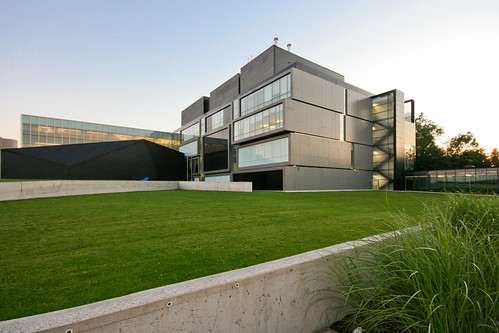
Communication, Culture and Technology Building by Saucier + Perrotte Architects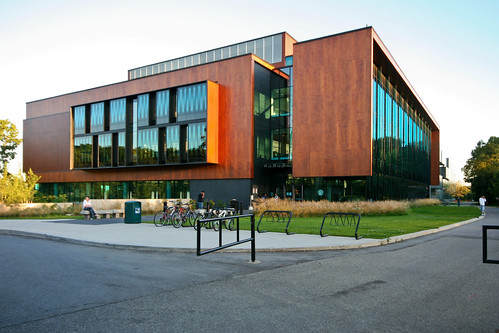
Hazel McCallion Academic Learning Center and Library by Shore Tilbe Irwin and Partners
To contribute your Flickr images for consideration, just:
:: Join and add photos to the archidose pool, and/or
:: Tag your photos archidose
Saturday, January 24, 2009
Flipping through a special edition of the German magazine A&W on the 50 best single-family houses in Germany at a newsstand yesterday, this design by w67 architekten bda schulz + stoll stood out from the rest.
[exterior view | image source]
What looks like a straightforward glass box is elevated well above one's head and the neighboring buildings. The lift is housed in a stone-clad volume at the front of the house; a slender column is all that otherwise supports the house at its front.
[exterior view | image source]
Like a contemporary interpretation of Le Corbusier's five points, the design both lifts itself above the ground and recovers this space on the roof, where a generous terrace provides a dramatic outdoor living area.
[terrace view | image source]
Situated on a steep slope in south Stuttgart, the house takes advantage of city views afforded by the site by providing additional outdoor space.
[terrace view | image source]
The interior photographs illustrate that the house is fairly typical of much minamilist contemporary architecture today: unadorned walls, a restrained material palette, a floating stair and generous glazing. The last brings the residents back to the outdoor rooms and view beyond.
[interior view | image source]
Even the frosted glazing in the bathroom has a connection to the outside, as the adjacent tree kisses the surface, like a natural pattern on the glazing. It's a subtle yet effective reminder of what surrounds the modern-day treehouse.
[interior view | image source]
Links:
:: w67 architekten bda schulz + stoll
:: Architektur & Wohnen Special Edition
Friday, January 23, 2009
 "There are very few people, just a handful, who have a relationship with their clothes like Daphne Guinness. The Guinness heir and fashion muse doesn't dress up or down. She dresses out"
Featured in the August 2008 issue of Vanity Fair
by Scott Onstott
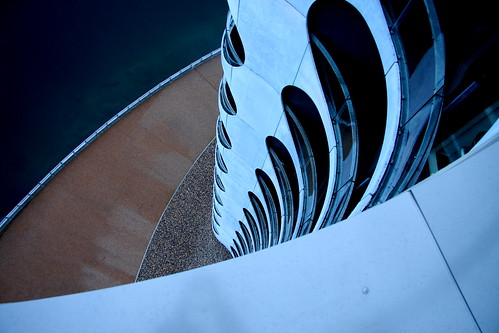
The Metropolis apartment building in Copenhagen, Denmark by Future Systems, 2008.
Last week Jan Kaplický, a founder of Future Systems, died at the age of 71. From the Future Systems web page:
Jan Kaplický 1937-2009
Jan Kaplický founder and partner of our practice died on 14 January 2009 in Prague, the town where he was born in 1937.
Jan was through Future Systems the founder and driving force of a new architecture that stimulated, amazed and inspired. He brought together people who shared his ideals and who were never content to remain with the status quo. In Amanda Levete he found a partner with whom he was able to realize his visionary concepts, often against prevailing attitudes, and their partnership was supported by many talented architects and designers over the years.
We are stunned and deeply saddened by the loss of Jan who was a mentor, co-conspirator, critic and inspiration to all who worked with him. His legacy will undoubtedly endure - he was a rare talent in the world of architecture and the reputation and success of Future Systems over the past thirty years stand as a testament to his relentless creative drive.
Our thoughts are with his children Josef and Johana and his wife Eliska Kaplicky Fuchsova.
To contribute your Flickr images for consideration, just:
:: Join and add photos to the archidose pool, and/or
:: Tag your photos archidose
Wednesday, January 21, 2009
Here's a few shots I snapped today walking past Cooper Union's New Academic Building by Morphosis under construction.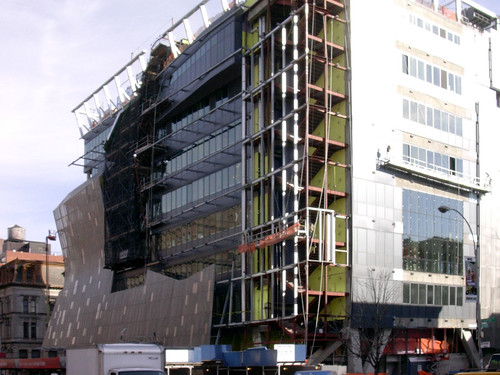
The building is located between 6th and 7th Streets, catty-corner from the school's main building. The above and below shots are looking northeast across Third Avenue, the street between the old and new buildings.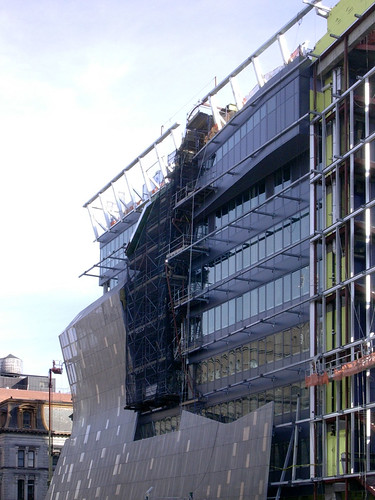
The below shot is the 7th Street corner, looking southeast. This is obviously the less-reserved of the building's two main corners.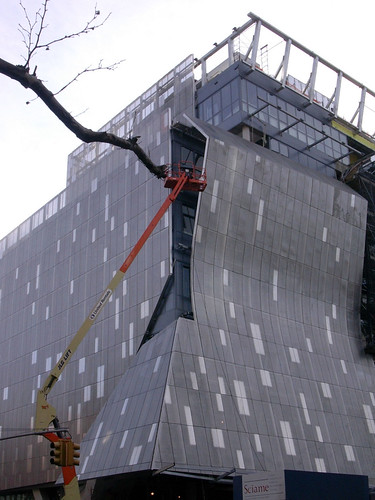
And finally here's a detail of the screen facade, what appears to be a perforated metal with an applique of apparently random, painted rectangles. The renderings indicate that this last is as intended, though I'm not sure if it's helping or hindering the design.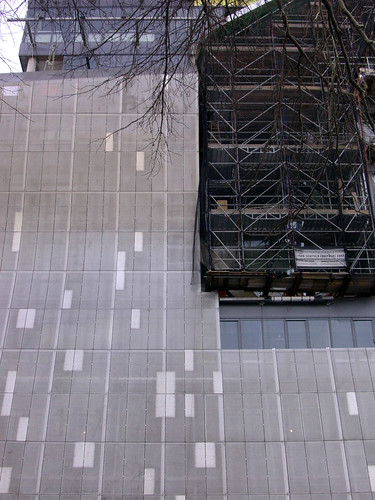
One can see from the first two photos that this metal screen will continue across the Third Avenue facade (minus the scaffolded area), mounted to the cantilevered horizontal frame in the spandrel area. So basically the screen is a sculptural veil of a dumb (and I'm guessing cheap) glass and metal box. The corner detail (third photo) illustrates this disjunction nicely.
Tuesday, January 20, 2009

 It was a case of being in the right place at the right time. We accidentally went to one of the few gates allowing non-ticket holders onto the route. We happened to be at the front of a line we didn't know existed in the chaos and got ushered to a few available seats in the grandstands! It sounds easy, but this involved about 2 hours of waiting. Just happenstance though...AMAZING
  signs on a nearby office building read 'welcome Mr. President'. Every building and roof of the surrounding buildings were crowded with viewers.
I wish I could describe to you the atmopshere at the parade other than saying it was magical. I have never met so many warm, friendly people. We were bound together by our excitement of the coming administration, our hope for the future and our FRIGIDITY. While it may not have felt cold at first, being outside in low 30 degree temperatures soon took its tole. It was worth all discomfort though.
 2 photos of the crowd surrounding us. It was packed! As the news reported though, due to the cold and long wait, as soon as the president's motorcade past, most of us left the stands and left the parade route. I had to get someplace warm!
 Security was tight but everything was managed surprisingly efficiently. While waiting in line the many volunteers tried to keep the crowd entertained with chants and cheers. The hundreds of thousands of spectators were incredibly patient and understanding while we waited in long lines with no clue what was going on, herded together like cattle (which was a blessing as it provided warmth and blocked cold winds). It will be a day I'll never forget and neither will my frozen toes!
 One of the bands in period costume which preceded the president's motorcade,
 While waiting for 2 hours for the parade to begin we all talked about where we came from, the cold, how we spent the morning and did 'the wave' up and down the bleachers while reciting different chants people knew. We were a rowdy part of the crowd, but even the police and army guards seemed to be in on the fun!
 an antique dc metro bus which led the president's motorcade
I felt like a part of this countries' history and of something bigger than just an individual citizen. I made so many friends waiting in line and while waiting for the parade to begin and was touched by their stories. I'll never know their names but I know many traveled long distances (not 5 blocks like me). A group of women drove all night from Toronto, tickets in hand; an older couple (pictured below with me in the hat) who came up from Texas, an entire family spanning generations from the Czcech Republic who came 1/2 way across the world just to see a parade and hope for the future.
 I hope you all managed to see some of the inauguration on tv and celebrate with me the hope and faith in the future of our country.
 President Barack Obama passing in his motorcade in front of the DC mayor's booth across from us, above and below.


