Thursday, April 30, 2009
Inflatable environments are undergoing something of a renaissance today. Not since the 1960's embrace of bubbles in their numerous connotations (lightness, transparency, embrace, equality, difference) have so many projects used air as a medium for shaping enclosures, although they are still on the outskirts of architectural production. Technological and other advances have aided, if not outright negated the disadvantages of "bubbletecture," namely durability and wastefulness.
[historical bubbletecture, top to bottom: 1960's inflatable by Jersey Devil (source); L: The Environment Bubble, 1965 by Reyner Banham & Francois Dallegret (source) R: Pneumakosm, a pneumatic dwelling unit, 1967 by HAUS-RUCKER-CO (source); Clean Air Pod,1970 by Ant Farm (source); page from Ant Farm's Inflatocookbook (PDF source)]
Of those exploring inflatable architecture in the sixties and seventies, Ant Farm was the most prolific, gearing a number of projects around air and plastic, and even creating an Inflatocookbook (PDF link). Fellow Americans Jersey Devil also explored what they called Inflatables in the early seventies, likewise created as "happenings" that stood out in their urban contexts, like alien crafts landed amongst the stone, glass and grass. In Austria upstarts like Coop Himmelb(l)au and HAUS-RUCKER-CO explored the possibilities of pneumatic dwelling units, yet without clients or sites they failed to get beyond the prototype stage. Even critic Reyner Banham got in on the act, combining the ideas of Bucky Fuller and Marshall McLuhan in a transparent igloo he designed with Francois Dallegret.
[Michael Rakowitz's paraSITE | image source]
The inflatable trend faded as fast as it started, finding use primarily for temporary stagings and art installations. Michael Rakowitz's paraSITE (1998-ongoing) can be considered part of the latter, though it engages the social, economical and political directly in the use of inflatable structures to house homeless individuals. By hooking the deflated plastic to a building's HVAC vent, a small enclosure is created, with the expelled air inflating the double wall. Importantly, in terms of my exploration of this architectural element here, the air used to shape and heat the space does not come into contact with the inhabitant; it is not part of the space itself, like the Ant Farm and Jersey Devil examples above. The design of the paraSITE's plastic shell is therefore much more complex, with many more seams, and even windows in the one on the left.
[Alexis Rochas's Aeromads | image source]
SCI-Arc's Alexis Rochas created Aeromads, installations from 2006 that questioned the domestic realm and harked back to ideas from 40 years ago, though Rochas's designs utilize the computer to create more complex forms. He "considers the idea that one’s home is a malleable, movable environment that can be deflated and fit into a suitcase, then travel to a new location with its owner. [source]" Again, air inflates what creates the enclosure.
[OMA's Serpentine Pavilion, 2006 | image source]
OMA and Cecil Balmond's 2006 Serpentine Pavilion in London can be taken as a purely symbolic attempt at reintroducing inflatables into architectural discourse. The inflatable enclosure sits above the main space, inaccessible and indirectly visible from below. But from afar the enclosure stands out, visible from a distance. The possibilities of using inflatable walls for architectural enclusre is not explored here, but like a moored hot-air balloon, the pavilion marks a space and place with minimal means, one of the advantages of air as a medium for architecture.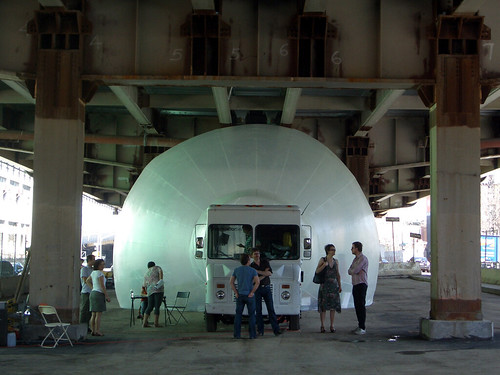
[Raumlabor's Spacebuster under the BQE | image source]
Raumlabor's Spacebuster has been in the news a lot lately, when it made its way around New York City on a ten-day tour. Spacebuster is part of the German architects' ongoing investigation of unused urban spaces, which started with inflatables in 2006 with the Kitchen Monument and includes last year's Glow Lounge.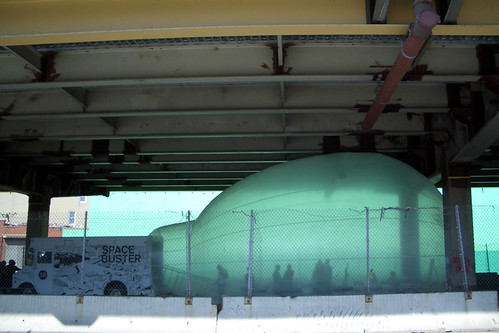
[Raumlabor's Spacebuster under the BQE | image source]
Their truck-towed events in New York included film screenings, performances and community meetings, the last under the BQE in Brooklyn the day before Spacebuster left town. Situated in a typically unused space, the community meeting used the opportunity to investigate other ways of doing the same. The possibilities of guerilla engagement with urban sites is certainly clear in Raumlabor's latest undertaking; one need only drive the truck to a parking lot, underpass or some other un/underused site and take advantage of the bubble until the cops arrive. The fact that the air and inhabitants occupy the same space, a la Ant Farm's and Jersey Devil's inflatables, makes this design suitable for these temporary happenings, but not necessarily a good precedent for further architectural investigation beyond the engagement of urban sites.
[mmw's kiss the frog | image source]
mmw architect of norway's 2005 kiss the frog was a temporary art pavilion linking four institutions in Oslo. The aptly-titled design is structured in parts like a tire, with powerful fans pushing fresh air into the spaces. The pressure difference between inside and outside air means the former pushes out on the PVC skin, giving the pavilion its shape. In designs like this, which require a constant supply of air and the energy to do so, necessitates a well-sealed skin and hatch-like access points to keep as much air inside as possible.
[Kengo Kuma's Tea House | image source]
The Tea House Kengo Kuma designed for the Museum für Angewandte Kunst in Frankfurt (yes, that one) a couple years ago is a double-wall membrane embedded with LEDs for nighttime use. Rooted in similar design investigations in his home country at the same time as Americans and Austrians were doing the same, most notably in the Fuji Pavilion at Expo 1970 in Osaka, the small yet complex project is documented in a book. This product that might be as or more influential than what is once again another temporary inflatable enclosure. The refinement of Kuma's design, filled like a 3d air mattress, points to an elevated level of sophistication possible with air as supporting structure. The double-wall enables openings to have free access, without worry and energy expended on keeping the air inside, and the high-tech skin provides for longer durability.
The above projects continue the temporary nature of inflatable architecture, but they point to their continued use in the coming years. Perhaps we'll see their longevity increase, as techniques of using air as a structural medium and membrane technologies improve.
Wednesday, April 29, 2009
 I want to thank Michele of My Notting Hill for naming my blog among her favorites in a fantastic interview done by Emily Leaman at Washingtonian magazine! Read the entire article HERE: she has some great solutions for common design problems that I think everyone will appreciate.
  All of our April showers have brought us beautiful May flowers! These are some fragrant lilacs I picked up tonight, aren't they beautiful!
Tuesday, April 28, 2009
 While reading this months Preservation magazine (magazine of the national trust for historic presevation) I came across a plea to save a bank by Louis Sullivan (whom I've blogged about recently here). Of course, Sullivan is a great architect. He was a key innovator in the modern movement and was mentor to such great architects as Frank Lloyd Wright and generations of students. However, I think this is bigger than just this one bank and I'm really upset! Of course, I'm going to blog about my feelings on the matter and I hope you take the time to read this unusually wordy post from me!
Our nation's cities were decimated by city planners in the 50s-70s. They are only now beginning to regain a little strengh and the sense of place they once had thanks to preservation efforts. The powers that be in Cedar Rapids, Iowa are planning on destroying what is left of their historic urban center as well as a NATIONAL ARCHITECTURAL TREASURE in a strategy they feel is a cost effective way to combat nature (building levees). 
One of the fundamentals of urban planning is to work with what the land is giving you, in many cases to the advantage of the city! Look at places who have prominently featured rivers and waterways in their recent revitalizations: Chicago, Austin, Pittsburgh, Providence and others are feeling the benefits of creative solutions. Older cities that are based on water management also prove to be popular and successful: Stockholm and Vienna as examples. What do we know about levees? Well...look at how well they worked in New Orleans. Is that a long term or even a creative solution?
So much good work has been happening in the past 20 years to save our nation's architectural heritage as well as our urban cores; to let Cedar Rapids continue on this OUTDATED path of destruction is monstrous. PLEASE join with me and sign the petition to make city planners of Cedar Rapids, Iowa consider alternative ways to manage flood waters and save their urban core! Sign the petition online HERE, I have!
Thanks to Hello Beautiful blog and Fred Camper for letting me use the photographs of the bank.

The Pod, a hotel and retail development (Bildurn) in Nottingham, England by Benson & Forsyth Architects, 2007. For more photos see New Nottingham.
To contribute your Flickr images for consideration, just:
:: Join and add photos to the archidose pool, and/or
:: Tag your photos archidose
Monday, April 27, 2009
 I've always loved the juxtaposition of the modern with the classical and we're seeing a lot of that latey here in DC. One of my favorite buildings is the Wilson building, otherwise known as the District Building, which houses the offices of the Mayor and city council on 14th street.
 The beaux arts facade with the crisp glass curtain wall always drew my attention. Both are great examples of their style and together just are that much more interesting. The original structure was built between 1904 and 1908 and the extensive renovation which includes the glass additions was completed in 2001.
 Recently I was able to view the interiors. The original building was a U shape which has been filled in with the 'glass box' you see on the exterior, but also leaving this interior atrium.
  What a great space this creates! I love that the modern additions respect the original structure both in scale and by not overpowering them. They work together as a team rather than fighting one another.

Like many episodes of The Simpsons in the last few years, last night's was just okay. As continued evidence that the writers are running out of ideas (in one way this is a good thing, meaning they have mined all the good ideas already), Homer becomes a "helicopter parent," hovering over Bart and Lisa to make the former less of a loser and the latter popular. The first concerns us here. Spoilers follow for those who haven't seen it, but FOX is nice enough to provide the full episode online.
For class Bart must create a scale model of a building out of balsa wood. (I recall doing the same thing, albeit in high school, with the Globe Theatre.) His first choice of Washington Monument is nixed by Homer, who realizes that choice is too easy. They undertake Westminster Abbey, with Homer taking over the balsa and blue glue reigns. As expected the model looks like crap.
What I really like is the choice of the other models revealed in the contest, including the CCTV Building in Beijing, China by OMA,
the Brazilian National Congress by Oscar Niemeyer,
and the Temples at Angkor Wat and the Taj Mahal.
As might be expected Bart wins the contest, because his model looks like he didn't have help from his father. As Bart has said in the past, "the ironing is delicious."
My weekly page update:
Chen House in Sanjhih, Taiwan by C-Laboratory.
This week's book review is Tiny Houses by Mimi Zeiger.
Some unrelated links for your enjoyment:
ArchiThings
"Daily blog on Architecture, Construction, Real Estate and Home Improvement." (added to sidebar under blogs::architecture)
The Craft of Architecture
A blog with "lessons learned about material selection, detailing, and construction administration." (added to sidebar under blogs::architecture)
What We Do Is Secret
A blog "about architecture, design and occasionally about scent" by an artist living in Brooklyn, New York." (added to sidebar under blogs::architecture)
Chicago Architecture in the Loop
"An Architect's Blog. Observation, and Comment from the Heart of Chicago." (added to sidebar under blogs::architecture)
2030 Forecaster
A free tool to "help project teams set energy mix goals for the 2030 Challenge."
bldgsim
"Tools for Better and more Sustainable Building Design." (added to sidebar under blogs::sustainability)
Sunday, April 26, 2009
On the subway yesterday I saw an ad for The Future Beneath Us, an exhibit at the New York Transit Museum and The New York Public Library. The joint exhibition is billed as "an illuminating look at the vast mega-projects that will bring New York City's underground infrastructure into the 21st Century and beyond." For those unable to visit the two venues -- The Science, Industry and Business Library’s Healy Hall, at 188 Madison Avenue, and the New York Transit Museum Gallery Annex and Store at Grand Central Terminal -- the online coverage is exemplary.
[8-project map | image source]
The eight projects are: 1) East Side Access 2) Second Avenue Subway 3) Fulton Street Transit Center 4) 7 Line Extension 5) Croton Water Filtration Plant 6) City Water Tunnel #3 7) Trans-Hudson Express Tunnel 8) World Trade Center.
Photos and text trace the history and provide a glimpse of the future via renderings of stations, for example. The most well known is surely City Water Tunnel #3, "the largest and longest running capital project in New York City’s history and among the largest engineering projects in the world," running for a total of 60 miles (96km) at a depth of 800 feet (244m), though the Second Avenue subway is probably a close second. All of the projects illustrate the importance of underground infrastructure in serving the people and buildings above ground, but they also show that infrastructure is always an incomplete project, dependent upon technology, the evolution of the city and financial constraints.
Saturday, April 25, 2009
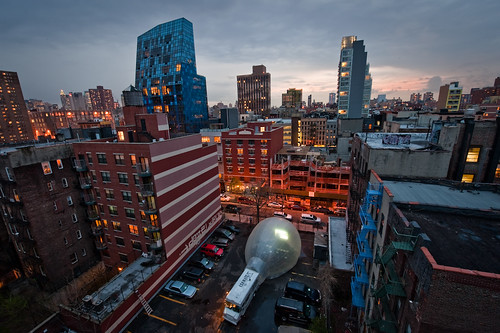
Spacebuster, a "a mobile inflatable structure - a portable, expandable pavilion - that is designed to transform public spaces of all kinds into points for community gathering," by Berlin's Raumlabor. See their Kitchen Monument for similar installations in Europe in 2006. The pavilion is in town (until tomorrow evening) for ten consecutive days of events in New York City curated by Storefront for Art and Architecture. Here it is used in a parking lot on Norfolk Street in the Lower East Side for a screening of Examined Life, a film by Astra Taylor.
See a tanz's Flickr set for many more photos of Raumlabor during its brief sojourn in New York.
To contribute your Flickr images for consideration, just:
:: Join and add photos to the archidose pool, and/or
:: Tag your photos archidose
Friday, April 24, 2009
 This past Thursday I was able to hear Stephen Drucker (current editor in chief of House Beautiful magazine with quite an impressive resume behind him) speak here in DC about how Nature informs interiors. Unfortunately, the opening of the DC showhouse at the design center meant a small audience.
 His lecture was very informal, extremely realistic and down to earth. Rather than preach about green living and practices, he tackled first how 'green design' isn't something new. Rather, it has been brought about every 30 years on average. He even showed the first 'green' issue of House Beautiful....from 1949!
 One of the problems he cited was that people will talk the talk but when it comes to the practice of environmentally friendly living, they don't want to be bothered other than with cleaning products. Green issues of magazines are among the worst selling issues each year. People want fantasy and pretty pictures from magazines (I have to agree). Stephen realizes that and admits it freely; when people want hard information and facts, they turn to the internet.
  Stephen ended the lecture with a slide show of different 'natural' interiors through time as featured in House Beautiful-starting with Frank Lloyd Wright in the 40s, going through Michael Taylor in the 70s and ending with Axel Vervoordt now. It was such a great opportunity to hear him speak and I hope if all of you get the chance you will go for it! He has really turned House Beautiful into a wonderful magazine and I hope to see its continued success!
With so few job postings for architects nowadays, Craigslist looks like it has become one of the best sources for finding job leads, at least in New York City with its relative multitude of listings. But alongside the few reputable ads are numerous gotta-be-a-headhunter ads (maybe not a bad idea these days), hire-me ads (ditto) and other questionable listings. I'll be posting some of the last, with some commentary, once a week until the economy improves or the idea runs its course, whichever comes first.
Title: HIP ARCHITECTURAL FIRM IN SOHO SEEKS A RECEPTIONIST/ OFFICE MANAGER
When: 2009-04-24
Who: ???
Description:
I am the current office manager for an architectural studio in SoHo. Sadly, I am moving & need to give up my position in this creative environment. We are on the hunt for a reliable, organized, detail oriented Receptionist/Office Manager. Must be professional with great communication skills. You have big shoes to fill!! No, seriously…they’re like a size 10.Comments: Granted that most out-of-work architects probably don't want to give up just yet and take a receptionist gig, I couldn't help feature this ad posted in the engineering category, where architecture listings reside. You can probably see why. This firm is so hip that: 1) They won't say who they are, lest they be inundated with thousands upon thousands of e-mails. 2) They make the office manager write the ad for the position she's leaving, since they can't take time away from making hip architecture. Let's hope they paid her (I'm guessing she's a woman, given the shoe size joke) for writing the ad.
Are you interested in being more than just a receptionist? Maybe Marketing or Human Resources interests you? Are you a self starter with consistent follow-through? Do you have working knowledge of MS Office and Adobe programs? Do you like friendly people that are fun to work with? How about working in an amazing neighborhood full of great food, shopping & culture? Then this might be the job for you!!
Fuel edited by John Knechtel
MIT Press, 2008
Hardcover, 320 pages
Alphabet City "is a series of annual hardcover anthologies originating from Toronto, Canada. Each volume in the series addresses a one-word topic of global concern and draws on the diverse perspectives of writers and artists from many cultures and disciplines." Previous books focused on Food and Trash, with Water forthcoming. These monickers point towards substances and processes that are threatened by humanity, or problems created by the same. One could argue that Fuel, namely oil in this case, while naturally available, is primarily a problem (in the name of climage change, pollutions, habitat destruction, etc.) created by humanity via its exploitation of the substance in sometimes questionable ways. (Do we really need to drive ourselves two hours back and forth to work every day?) This book, small in stature (just over 4x6") but large in ambition, proposes energy pluralism, the reworking of infrastructure and the rethinking of Fuel towards opening up unforseen possibilities.
The contributions fall into two broad categories: descriptions and analyses of existing conditions and proposals for future scenarios. Photography comprises much of the former, such as Edward Burtynsky's well-known documentation of scarring created by excess and George Osodi's disheartening images of the oil-rich (not people-rich) Niger Delta. Essays, like Mason White's analysis of the Barents Sea and Dubai, yield greater understanding of areas relatively unknown and hyped beyond belief.
The proposals range from small to XXL, from a parasitic residential unit (A.I.R. by Lateral Architecture and Sarah Graham) to a long-term plan for occupying the Caspian Sea by Maya Przybylski. These indirectly touch on the paradox of addressing environmental and other problems, namely if solutions should be small- or large-scale. The answer most likely is both, but the resources required by the latter may preclude many ideas from being implemented, like RVTR's design for pumping up the bandwidth of highways, in which elevated trains and median wind farms would make the highway itself pale in scope and expense, a trait shared by Chris Hardwicke's elevated Velo-City bike lanes. The proposals are carefully crafted, and a number of them have every intention of being realized to some extent, but more than likely the designs will provoke and inspire rather than find themselves in production.
Most unsettling is the disconnect between the photographs of Burtynsky and Osodi and these proposals. Will the latter improve the conditions of the former, or will exploitation reign over those not fortunate enough to find themselves cycling in an elevated bike lane in Toronto? The relationship is not addressed, except for Kelly Doran's proposal for bringing North Alberta's Tar Sands back from a point of no return. Not surprisingly, here the focus is on native soil. Even though it is clear from the photographs and essays of the first category that local decisions affect remote places, it's a difficult fact to address. Yet is one that might find a voice in future books in the series. or
or 
Thursday, April 23, 2009

 You can see the old knobs above: Cheap aluminum finish and just a boring design. I've tried out a few different knobs but nothing has ever worked -TILL NOW! I found these Ephram knobs at Restoration Hardware that I just LOVE!

Here's some photos taken by ken mccown of the Antioch Baptist Church in Perry County, Alabamy by Rural Studio, 2002.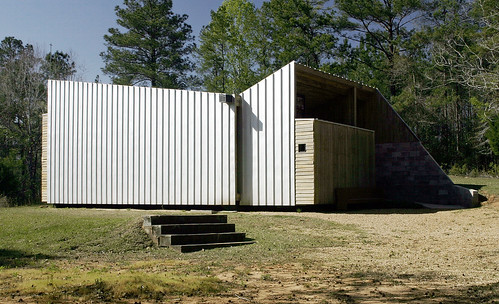
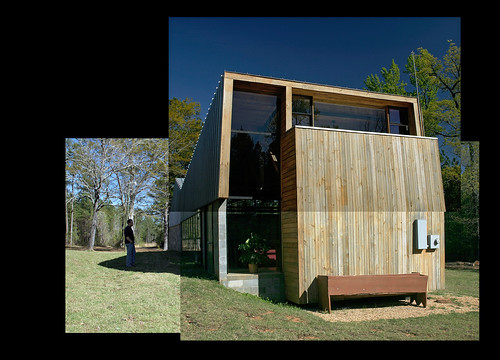
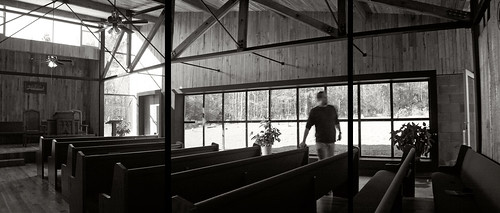
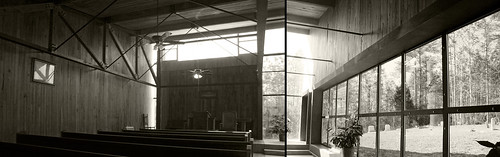
To contribute your Flickr images for consideration, just:
:: Join and add photos to the archidose pool, and/or
:: Tag your photos archidose
Wednesday, April 22, 2009
Here are some sobering satellite photos of Las Vegas, in five year intervals from 1984 to a few months ago, taken by NASA's Landsat 5. For orientation, the strip runs north-south and with a NNE kink just right of center, with the airport parallel to this at bottom. Interstate 215 can be found in the bottom left corner, taking shape in 1999.
Click the animation for larger images.
[25 years in six seconds | images from here]
"These images of the western portion of the Las Vegas metropolitan area show the city’s steady spread into the adjacent desert landscape. Undeveloped land appears along the left edges of the top two images. Here, the land on the city’s outskirts appears in shades of beige and tan, with just a hint of the street grid to come. By 1989, however, development filled the upper left corner—a residential area, complete with curving roads and semicircle streets. In subsequent images, development spreads southward, and by 2004, the entire image shows cityscape, including Interstate 215 passing through southwestern portion of the city."(via Coudal)
 While walking home yesterday I snapped some dramatic looking photos of the beautiful ironwork gate surrounded the Cosmos Club in Dupont.
 Aren't the finials really elegant? The ironwork is so fluid: a true art form!

