Sunday, May 31, 2009
My weekly page update:
Step Up on Fifth in Santa Monica, California by Pugh + Scarpa Architects.
This week's book review is Materiology: The Creative Industry's Guide to Materials and Technologies by Daniel Kula and Élodie Ternaux by Author.
Some unrelated links for your enjoyment:
Public Art Fund
"New York's leading presenter of artists' projects, new commissions, and exhibitions in public spaces." A Clearing in the Streets, a temporary landscape designed by Julie Farris and Sarah Wayland-Smith was unveiled last Wednesday. (added to sidebar under architectural links::new york city)
TommyManuel.net
"The blog of Tommy Manuel, Architect. It contains thoughts on architecture, design, planning, preservation, and anything else these may engage." (added to sidebar under blogs::architecture)
rory hyde dot com blog
Blog of graduate architect Rory Hyde, now working at Volume Magazine. (added to sidebar under blogs::architecture)
Design with Intent
"Architecture of control, design for sustainable behavior, by Dan Lockton." (added to sidebar under blogs::sustainability)
Agoraphobia
"Global architecture discussion." (added to sidebar under architectural links::forums)
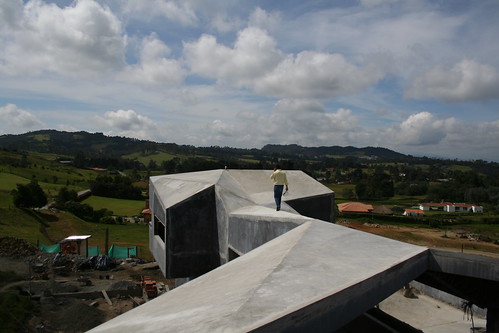
Casa en Ladera in El Retiro, Antioquia Colombia by Paisajes Emergentes, 2008.
To contribute your Flickr images for consideration, just:
:: Join and add photos to the archidose pool, and/or
:: Tag your photos archidose
 This past weekend I saw the new Pixar movie, UP. WOW! You all have to see it; It may be the best Pixar movie yet! I wouldn't take very young children to it though, it has some very sad situations that were hard enough for me to take! The animation is superb and the writing is excellent. Even the small 'short' before the movie was really entertaining!
 Without giving too much away, the premise is an elderly widower who attaches 1,000s of helium balloons to his quirky Victorian house to fly to South America! Don't ask, just go; Let me know what you think!
Saturday, May 30, 2009
Below are upcoming lectures and ongoing exhibitions in and around New York City for the next 31 days. This calendar is curated by me and powered by Bustler; click the links to visit the Bustler entries for more information.

On the left is the Philharmonie (2005) by Atelier Christian de Portzamparc with L'Hotel Evenement de la Place de L'Europe (2009) by Jim Clemes in the center, in Luxembourg's Kirchberg Plateau.
To contribute your Flickr images for consideration, just:
:: Join and add photos to the archidose pool, and/or
:: Tag your photos archidose
Friday, May 29, 2009
 I feel a bit uninspired lately, I have to apologize for that. I want to thank the kind people who have emailed me to make sure I'm ok: I'm fine and just a bit pre-occupied! Hopefully the weekend will rejuvenate my blogging sensitibilites and 'think different' as this old Mac ad proclaims with the divine Callas. I hope her singing will inspire you this weekend!
Wednesday, May 27, 2009
On Sunday, city crews closed sections of Broadway in Times Square (from 42nd to 47th Streets) and Herald Square by Macy's (from 33rd to 35th Streets). In a New York Times article by Nicolai Ouroussoff, and an accompanying slide show, we see the dramatic change that occurs when cars give way to people on foot, but we also read about how much work still needs to be done to make these actually well-designed spaces in the city.
While I have experienced last year's improvements of the 34th-42nd Street and Madison Square Park stretches of Broadway (lifeless or lively depending on weather and time of day), I've yet to walk these new pedestrian promenades. Nevertheless their repetition of last year's combination of safety bollards, tables and chairs, and (maybe) some surface aggregate and paint is a rudimentary response to a long-term vision for making parts of the city more amenable to pedestrians. It's clear from photos that the city's urban designers need to step up to make the design of these pedestrian areas reflect the intentions behind the car-closing.
[Broadway in Times Square Saturday and Monday | image source]
Much of the decision to create these pedestrian zones comes from the input of Denmark's Jan Gehl. As Ouroussoff points out, the success of Copenhagen's pedestrian areas took a long time and was a pull-and-take effort where closings were tested over time. The same appears to be happening in Manhattan, but the city must realize that the design of the street will play a part in the success of the closings, as will be what abuts the street, its frontage. In my opinion these stretches of Broadway are not the best test cases, chosen most likely for being tourist locales and therefore making impressions on visitors. It lacks the intimate scale and fine-grain retail of Stone Street or the continuity of just about any east-west street. The breaking up of the pedestrian zone by cross-town traffic that Ouroussoff mentions reminds me of the ubiquitous summer street fairs, hardly a great precedent for a pedestrian takeover of what truly belongs to them, but a worthy comparison.
The street fairs illustrate the importance of scale and frontage in a pedestrian zone. Typically occupying the wide north-south avenues, the street fairs delineate a smaller space down the center of the street, in the placement of the repeated bays of tents where the backs of the tents "front" the sidewalk, ironically making this typical pedestrian zone empty. And by fronting the new pedestrian zone in the center with food, music, wares the space is activated. The temporary fairs clearly indicate how scale and frontage activate pedestrian life, but they leave little to be desired in terms of design and the crass commercialism of the enterprises. I think narrow east-west streets would be great candidates in Manhattan for pedestrian zones, becoming public spaces more like parks than like retail malls, catering to residents instead of tourists, fronted by stoops not Duane Reades. And let's not forget there's plenty of areas in the other boroughs worthy of car-free streets.
Eric Sanderson's Mannahatta, a book, exhibition, and upcoming competition is sure to be a talked-about project this year, as it visualizes the island of Manhattan 400 years ago, when Henry Hudson arrived, and when the island was inhabited by natives. Striking and subtle juxtapositions show the differences between the island then and now.
[Mannahatta Project's view of Mannahatta ca. 1609 overlaid with today's footprint of Manhattan | image source]
Sanderson's ambitious, decade-in-the-making undertaking reminds me of a small plot of land in Greenwhich Village that recreates Manhattan's forest from 400 years ago. Alan Sonfist proposed Time Landscape of New York for the northeast corner of LaGuardia Place and Houston Street in 1965. It is located on the same block as I.M. Pei's University Village.
[Artist's statement | image source]
[Artist's plan and elevation | image source]
Construction started in 1978, during the Koch administration, though naturally the site has slowly evolved since then. The 1,000 sf (93 sm) plot is divided into three sections reflecting the three stages of forest growth (grasses-saplings-trees) with wildflowers throughout. The accessible park is one of the city's Greenstreets, city-owned land devoted to transportation but converted into green space. Maintenance is aided by volunteers.
[Street and aerial view today | image source]
As a piece of landscape art, the small park raises obvious questions about our relationship to the city and its nature. The natural in this sense has been obliterated, so even Sonfist's intervention is what can be called second-growth forest, obviously too small to carry the benefits of larger forests, though certain species (bugs, birds, people) do enjoy the diversity and density of vegetation. It's easy to miss this patch of green while walking either LaGuardia or Houston, but given the layered meanings in the park it deserves a second look and a slight detour inside the fenced-off landscape.
Tuesday, May 26, 2009
Here's a few views of the latest Studio 804 house, 3716 Springfield. Studio 804 is a design/build program at the University of Kansas School of Architecture and Urban Design directed by Dan Rockhill. For more information check out my TENbyTEN article on Rockhill and Studio 804, "A Reality Dose on the Prairie."
Photographs are by archaalto, who has many more photos in his flickr set on the project.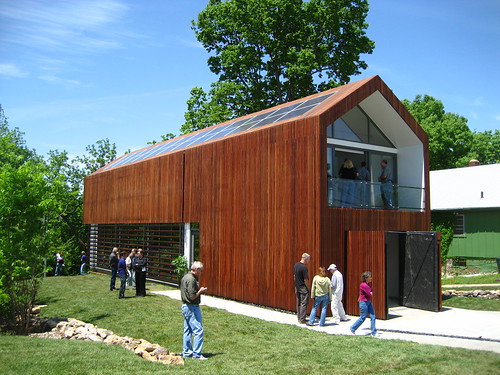


To contribute your Flickr images for consideration, just:
:: Join and add photos to the archidose pool, and/or
:: Tag your photos archidose
Monday, May 25, 2009
In early 2007 I posted about the $836.00 winning bid for Peter Zumthor Works on ebay. At that time sellers on Amazon.com were asking $974.73 for the first edition (red cover) of Thinking Architecture, another highly-prized, out-of-print title by the Swiss architect. But now that Mr. Zumthor has won the Pritzker Prize, the price of that slim volume has changed...dramatically. As of last night two sellers are vying for collectors of first editions, with only one penny separating the two:
[not sure why the author is "Princeton Arch Staff", given that the publisher is Lars Muller and the author is, obviously, Peter Zumthor.]
I held on to Thinking Architecture, even after wondering a couple years ago if I should sell my copy for close to a grand and then go see some Zumthor buildings in person. These prices make me think I made the right decision, but on second thought I don't think the title will fetch two grand. Will somebody really pay that much for this first edition? More specifically, will architects -- really the only audience for the book -- pay that much? Not likely.
 This past weekend, I went to the National Building Museum to check out some of the new, and very interesting, exhibits. They have the best gift shop in all of DC: Fun games, household items and every design book under the sun! I picked up a few postcards from Monkey Designs which contain parts to build models of some houses -you can see a few above.
 I bought 7 and thought I might build 1 or 2 for some fun. I built 4, just couldn't stop myself! I started with the Georgian house you see to the far right, then progressed to the yellow Greek Revival style house which was a bit harder. I then moved onto the pagoda which, while it had a lot of steps -wasn't as hard as the French Styled house with lantern on the roof (a lot of swearing went into the creation of that TINY lantern). These houses stand about 1 1/2" high - TINY pieces to cut out with an exacto-knife!
 a blurry picture of my weekend projects. The 3 left are a Greek revival house, Buckingham Palace and Chartres Cathedral.
Sunday, May 24, 2009
My weekly page update:
Incremental Housing Strategy in Pune, India by Urbanouveau.
This week's book review is Urban Design, edited by Alex Krieger & William S. Saunders.
Some unrelated links for your enjoyment:
For Architects
A searchable database of architecture firms around the world. (added to sidebar under architectural links::online journals)
GAB Report
GAB = Green Architecture Building Report, "a resource for sharing information on responsible, green, and sustainable design, ranging from the architecture to the building details, and from the site features to the building products." (added to sidebar under blogs::sustainability)
Urbanautica
"A search by images, words, signs, colors on places of living. A sailing by sight, a trip around ideas, people, and what makes them part of nature, and the world." (added to sidebar under blogs::urban)
Talkitecture
"A space dedicated to the discussion of contemporary world architecture, art and design." (added to sidebar under blogs::architecture)
AIA/NY
The redesigned web page of the AIA New York Chapter.
 In honor of Memorial Day here in the US, I've decided to focus on a monument most of us probably aren't familiar with -the Australian War Memorial in Canberra, Australia's capital.
 The memorial was first conceived after WW I. However, a competition for the design of the structure wasn't completed until 1928. Because of the great depression, the monument then wasn't finished till 1941. The style remains Art Deco which was popular at the time. Housed in the building is also an Australian military museum.
 interior of the dome above the Hall of Memory. Stained glass depicting the virtues of soldiers surround the space, you can see one of them above. They were completed by Napier Waller, a 1-armed veteran who also did all of the mosiac work here in the hall.
 The central courtyard.

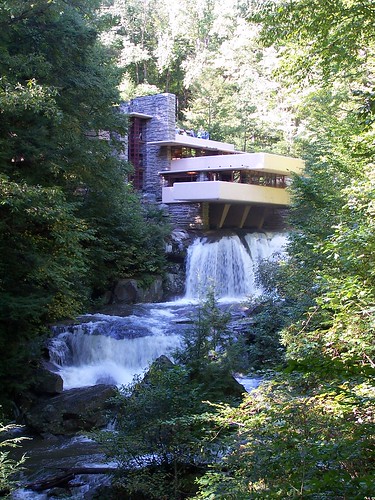
Fallingwater (aka the Edgar J. Kaufmann Sr. Residence) in Bear Run, Pennsylvania by Frank Lloyd Wright, 1934.
For those who can't visit the house in Pennsylvania or see the large-scale model in the exhibition now at the Guggenheim in New York, a LEGO kit is coming soon.
To contribute your Flickr images for consideration, just:
:: Join and add photos to the archidose pool, and/or
:: Tag your photos archidose
Saturday, May 23, 2009
Inspired by Nature: Animals by Alejandro Bahamón & Patricia Pérez
W.W. Norton, 2009
Paperback, 192 pages
In an exhibition of Andreas Gursky's photographs years ago one image made me think of the relationship between the habitations of humans and other creatures. Shanghai portrays an a building's atrium, with its yellowish tone and curving form immediately recalling beehives. Trying to move beyond a merely formal comparison, I thought at the time that the "human nature" that drives us to live collectively is not too far removed from other creatures, be they insects, mammals, or maybe even birds. So the formal morphology of what we build will find a number of resonances with habitats made by animals lacking the consciousness that is our blessing and curse. This idea links us to the creatures we share the earth with, but it also makes our harmful practices excusable to a certain degree. (We are doing things naturally, just like other creatures, so we don't need to worry about the impact of our actions.) Counter to this would be an approach to building that finds inspiration from all creatures great and small, thereby leading to an appreciation and respect of their lives, too.
The Inspired By Nature series by Alejandro Bahamón, Patricia Pérez and others can be seen as an embodiement of this approach. What at first glance sounds like a rational for another collection of contemporary architecture is actually a thoughtful investigation of the myriad ways designers are influenced by their surroundings. Previous titles looked at Plants and Minerals, with this latest installment focused on animals. The survey of 26 projects is split into four sections (Anatomical Structures, Animal Constructive Structures, Social Animal Constructive Structures, Temporary Animal Structures) with the first loaded with nearly half of them. The naming clearly indicates that structure is what influences architects, be it the skin and bones of animals or the habitats they build individually, collectively or temporarily. Nevertheless, not all of the projects included are necessarily inspired by nature, meaning the architects did not set out to replicate the anatomy or habitats of animals. As well, the book does not include obvious projects by the likes of Santiago Calatrava, whose sketchbooks illustrate his fondness for the elegance of animals' skeletal structures, or Herzog & de Meuron, whose Bird's Nest clearly spells that stadium's influence.
What is included ranges in size, location, and building type, from well- and lesser-known architects. Highlights include a renovation of a pig barn by FNP Architekten, a bus station curved like a shell by Justo García Rubio, an apiary by Marlon Blackwell, and a house with a kangaroo "pouch" by Hiroshi Nakamura & NAP Architects. These illustrate the range of projects presented, respectively showing how concept and process are as important (or more so) than form in human/animal comparisons, how form and structure can find a symbiosis readily found in animals, how animals can actually be part of a building's function (in this case bees), and how a playfulness can extend from finding inspiration in the animal world. The text by Bahamón and Pérez does a good job of explaining each project's inclusion in the book, without belabouring the point. Color photos and drawings predominate, alongside sketches of the animals and habitats that give architects inspiration free of charge. or
or 
Friday, May 22, 2009
 I was walking home the other day and noticed that the roses are coming out in full force. I guess summer is upon us! I hope everyone has a great weekend and takes some time to smell the roses!

Thursday, May 21, 2009

 Released in conjuntion with a show at the Guggenheim (of which there is also a model, seen above) called 'From within Outward' with the help of the Frank Lloyd Wright Foundation these sets will help young budding architects learn a bit of American Architectural History piece by piece. The show at the Guggenheim looks pretty great too, I need to head up to New York to see it before it closes in August!
 Also in the series is a BEAUTIFUL (but expensive at $299) set of the Taj Mahal.
 The Empire state building above and the Seattle Space needle below are just as fantastic and a much more reasonable $20. For nieces, nephews, children -anyone? I can't wait to see what comes out next in the series!
Title: Project Architect: Public and Design Excellence projects
When: 2009-05-18
Who: Robert Siegel Architects
Description:
Comments: Oh, where to begin with this one. I can't tell if it's a job posting or advice for job seekers. It seems odd that a firm looking to hire would talk about using "care in selecting the paper, the font, and the organization of text on the page." It sounds controlling as well as very, very particular. What's probably most unique about Robert Siegel Architects is the test they administer, the first step in their three-step process towards being hired. Many architects might not be willing to put up with such a process, but today I'm guessing many won't think twice about it. But what's most interesting about these Siegel ads is the number of them, as they pop up on Craigslist regularly--for at least half a year now--as well as on other job boards. This makes me think Siegel isn't really hiring to fill a position, that they are shopping around for the best and brightest. This is speculation, and if correct it's their prerogative, but nevertheless it's mildly unsettling, as if the current state of the profession is an opportunity to mine talent towards hiring, maybe, at a future date. But, like I said, this is speculation.We are looking for talented and passionate architects who are excited about making buildings and working outside their comfort zone towards innovation in architecture. Hard work and dedication, combined with inspiration and drawing ability, is one thing that all staff members share. You must have truly excellent written and oral communication skills.
Cover Letter with Salary History:
Send us a brief, signed cover letter specific to Robert Siegel Architects that states why it makes sense to hire you. Graphic presentation is key. This is your first impression and demonstrates your ability as a designer. Use care in selecting the paper, the font, and the organization of text on the page.
One-Page Resume:
People who have stayed at a firm for 4-5 years are very attractive. We are looking for great experience and commitment. Limit your resume to one page only.
Your Work Samples:
Show us only your best stuff and the work you are most passionate about. You should showcase your abilities - whether it is a sketch, a floor plan, a construction detail, wall section, spec section, watercolor, etc. So long as it is your work, we are interested in seeing it. Please do not show renderings made by others. Submitting renderings other than your own will lead to automatic rejection.
Test:
After making it through the first resume review process, we give selected promising candidates a graphic test in our office. The goals of this 20 minute test are:
Personal Interview:
- Drawing ability using a pencil. This is a tool that architects use to communicate. In our office we are always drawing and sketching freehand.
- Passion for architecture and analytical ability. There is a portion of the test in which you have to draw a plan and a section or elevation of any piece of architecture. Amazingly, either history is no longer taught or the relevance of our architectural past is not integrated into design curricula since most people fail this portion catastrophically.
- Basic design ability. This is a classic "Architecture 101" test to measure spatial design ability.
You will be asked to present highlights of your work and a detail or two. Move quickly and ask questions. Let the person conducting the interview hold the portfolio and turn at their own pace. You must demonstrate your ability to edit and to be concise. Do not be late: Make sure that you are on time and are dressed as if you were meeting with a valued client.
Professional References:
You should have outstanding professional references that are able to talk about your specific strengths and abilities. Please have these ready to give at the conclusion of a personal interview.
ABOUT THE JOB:
Are you a talented architect with 5 to 10 years experience? Do you enjoy working rigorously on exciting design projects for demanding clients? Do you love to draw, make models, and visit construction sites?
Would you like to work on projects ranging in size from $500,000 to $150 million in construction value? Are you energized by the idea of working with outstanding public clients including the United States General Services Administration and the New York State University Construction Fund? Do you enjoy working with private companies and high-end private residential clients?
Robert Siegel Architects focuses on architectural innovation, every day, for every client. Our staff is an energetic and talented group drawn from all over the world with a passion for architecture and expertise in design, technology, urban and graphic design. We offer a great working environment, a comprehensive benefits package and competitive salaries.
If you would like to be part of our growth and are interested in contributing to the creative process at a design, detail and management level, we would like to see your work. For consideration please mail (no emails, please) the following:
Please send to:
- Cover Letter with salary history
- Resume
- Work Samples that demonstrate your design and technical ability
Robert Siegel Architects
Attn: Suzann Wolfe
37 West 37th Street, 12th Floor
New York, NY 10018NO PHONE CALLS OR EMAILS PLEASE
Wednesday, May 20, 2009
 This past Saturday I hosted local design bloggers for a meet'n greet High Tea at my apartment. A few of us had met before, but it was so great to be in one room all together. We are trying to keep up our blogging social meeting once a month - power to the DC bloggers!
 Here you see Beth of Style Redux and Chinoiserie Chic serving champagne to the guests.
Only a blogger can know how fun these online friendships can be. We get to share our design passions and interests online daily with one another and it's fun to bring these into real life conversations! Michele from My Notting Hill poses by the drinks station. Champagne, lemonade, sparkling water, tea and coffee were the drinks of the day.
 Allie from Summer is a verb took some artistic shots of the tea table, which she thinks are blurry but I think are more impressionist!
 Strawberry shortcake, croissants, tea sandwiches and some other snacks all proved popular!
 And the spread afterwards -chaos and empty plates show that everyone had their fill! I used my Harebell by Coalport china for most of everything, but couldn't resist using a plate from my strawberry cream service by Royal Doulton for the tea sandwiches to go along with the strawberry theme!
 The peonies even got some showtime in the bathroom - I put one single flower in a bud vase to liven up the sink.
 As little 'host' gifts, I gave away my favorite carrotcake cupcakes from Georgetown cupcake -a nice little treat for the ride home :-) Hopefully this will encourage you to meet some of your local blog buddies!
Shortly after the announcement of Peter Zumthor as this year's Pritzker Prize winner, critics took aim at the Swiss architect's focus on the aesthetic and experiential qualities of space and his apparent lack of politics or confrontation with the myriad crises at hand today. Examples include Christopher Hawthorne's assertion that "Zumthor's work has nothing to do with social activism, disaster relief, sustainability, new design software, mega-cities, affordability or infrastructure -- all of which have crowded together recently near the top of the profession's agenda -- [his winning is] a boost for the idea that architecture is fundamentally an aesthetic rather than a political profession." James S. Russell calls the winner a "Swiss Hermit" and says the jury "avoids contemporary challenges" and "left me wishing it had been more adventurous." Clay Risen goes furthest in his call to "Fix the Pritzker," stating, "there's a real opportunity to reorient architecture toward more humane, socially engaged goals. Getting rid of the Pritzker—at least as we know it today—would be a good start."
Additional, less-critical coverage includes Paul Goldberger fairly typical portrait of "Zumthor's Quiet Power," Richard Lacayo's coverage in Time Magazine, Thomas de Monchaux's essay on "The Mystery of Peter Zumthor" and interviews with Zumthor at The Architect's Journal, with Blair Kamin and with Edward Lifson.
I'm interested in addressing the critiques linked in the first paragraph above, ones that think Zumthor is not a political architect because he does not deal with what are held to be political issues, such as those mentioned by Christopher Hawthorne. Politics in these cases is defined one way, an engagement with government and its policies. Architects are always dealing with government, even if they are building a relatively insignificant structure like a hot dog stand, because they are following codes, zoning and other rules established by governments. But Hawthorne and others want architects to go beyond this and engage governments in their choice of commissions and their working process, leading to buildings that formally express this engagement. I would argue that these three parts of architecture (project selection, process, formal product) are political in Zumthor's work, though not in the view of politics held above, and that architects can learn by his actions.
The definition of politics I would adopt is "the often internally conflicting interrelationships among people in a society." Henri Lefebvre's assertion that "(social) space is a (social) product" is perhaps the best sentence describing this fact, though it gets lost in today's tumble around big issues and bigger plans. Basically this definition and quote situate all architects and their projects within a political process of building and shaping space. Architects are but one role in the process, which also involves the government, the landowner, the builder, the current occupants and future occupants, the neighbors, and more. In capitalist society certain roles are stronger in shaping space, but in most cases all are able to take part in the process, even though it may not be so obvious, so easy or so successful. Architectural projects in democratic societies can be seen as the utmost expression of politics, in that the conflicting interrelationships are played out in space, with the help of money, power and (free) speech. Architects tend to either play down this fact, in favor of relegating the political to the client and ignoring the importance of form in public space's contested realm, or taking up the cause to the extreme, like Architecture for Humanity (AFH) and other architects fighting for the public whose voice and wants are usually squashed in the process of building. Basically, all architects are political -- like it or not -- and how they practice situates them within a gradient from ignorant to activist.
So where is Zumthor in this gradient? Returning to the three parts of the architectural process mentioned above (ignoring teaching, writing and other marginal aspects that influence the process but are not directly involved), he is closer to being an activist than an ignoramus, because he is very selective of the projects he takes, he works on projects for an amount of time much longer than most architects, and he creates buildings at odds with most developer-driven architectural production today. Of course these are all related (the second aspect makes the first a prerequisite, for example), but in this way of practicing Zumthor is advocating for an architecture not only distilled to its essence (as many critics attest, correctly or incorrectly) but also that engages its physical, social and political contexts in a very particular way. He does not choose projects that aim to make a quick buck or whose presence is harmful environmentally or socially. He works a long time to make buildings that last a long time, not disposable architecture. And his forms raise one's appreciation of his or her surroundings, without excluding everybody but a select few (many of his projects require payment for admission, so they are not totally accessible).
Zumthor is not the model architect, that is obvious. His idiosyncratic ways and designs, though, should be commended as an alternative to more standard practices that are complacent in their adverse impact on the environment and social life. Few architects can practice the way he does, but the same can be said about architects or organizations like AFH. I believe we need these and other architects who make the political gradient that much more diverse, calling attention to the architect's role in the "conflicting interrelationships among people in a society."
Tuesday, May 19, 2009

The Burnham Pavilion in Chicago's Millennium Park by UNStudio, 2009. This is a construction shot of this week's dose.
To contribute your Flickr images for consideration, just:
:: Join and add photos to the archidose pool, and/or
:: Tag your photos archidose
Monday, May 18, 2009
 Recently while reading the Elements of Style blog I came across the plea to save La Ronda. I have to admit I had no idea what La Ronda was, but I instantly recognized the building as one that was designed by Addison Mizner, the famous architect, as his last commission in 1929.
  The current owners, who wisely are remaining anonymous (trust me, they'd be getting numerous phone calls and emails from me otherwise!) wish to tear down this architectural treasure for something slightly smaller, more modern and 'with air conditioning'. Seriously - tear down a gem so you can get something as basic as air conditioning. With a little ingenuity and a good architect & mechanical engineer you could have AC anyway. NEWS FLASH -that is not an excuse to tear this place down. And I have to ask -why did you buy it in the first place?

 The house is filled with beautiful details that are painstaking to reproduce and rarely are. The house was $3,000,000 to build back in the 20s (more than what the current owner paid for it) -imagine what it would cost today? Tear it down? What?!
  A grass roots effort has started to save the mansion through their local conservancy group, Lower Merion Conservancy and a cause that I support annually, The National Trust for Historic Preservation. I'll let you know if something comes through that we can help save this place. Currently it looks like the only way to save it is for a conservation minded purchaser to step forward. I've contacted numerous members of the local commission and they all say any buyer who intends to keep the mansion intact has their full support. The current owner paid only $2.5 million for the mansion, how much do you think it will take to make them release it from their deadly grasp?


