Monday, August 31, 2009
 Chateau Miromesnil is known for it's architectural beauty but also the wooded country in which it sits and its vegetable gardens (seen below). It has also been home to some famous characters.
  The famous author Guy de Maupassant was born in the chateau in 1850 while his parents rented it for 3 years.
Earlier the chateau had been home to Armand-Thomas Hue de Miromesnil. Armand was made a Knight of the Holy Spirit Order by King Louis XVI and later tried to defend the King at his trial during the revolution. He also abolished the use of torture for those who were imprisoned for supposed crimes. He died here in 1792 and left his fortune to the peasants of his estate. Of course the chateau has its own private chapel, as most ancient estates do. Solid and square -don't you think?
The chateau also acts as a bed and breakfast with very reasonable rates! Can you even imagine staying here? Heaven!
Visit the official website HERE
see information about renting rooms and photos HERE.
Sunday, August 30, 2009
My weekly page update:
Montauk Residence in Montauk, Long Island, New York by Pentagram Architects.
This week's book review is Le Corbusier: in his own words by Antoine Vigne and Betty Bone.
Some unrelated links for your enjoyment:
architecture buzz!!
"Buzz by architects." (added to sidebar under blogs::architecture)
Blue Architecture
The blog of "Eric McNeal, a licensed architect in the state of Colorado, a LEED Accredited Professional, and the Principal of the architecture firm S7g Architecture." (added to sidebar under blogs::architectureoffices)
Emergent Urbanism
"A blog about the new science of building cities." (added to sidebar under blogs::urban)
hugeasscity
"Seductive congestion. It’s what the best cities are all about.*" (added to sidebar under blogs::urban)
Veg.itecture
A spin-off site from Jason Landscape+Urbanism King that "focuses on the representation and implementation of green roofs, living walls, and vertical farming solutions from around the world." (added to sidebar under blogs::landscape+maps)
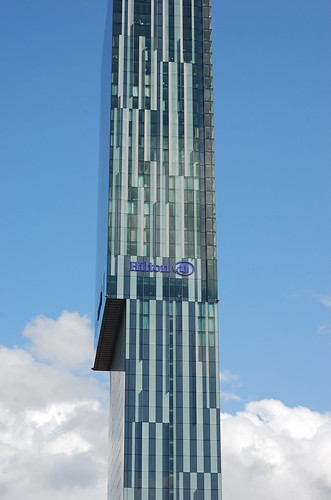
The Hilton Manchester Deansgate Hotel by Ian Simpson Architects, 2007.
To contribute your Flickr images for consideration, just:
:: Join and add photos to the archidose pool, and/or
:: Tag your photos archidose
Saturday, August 29, 2009
Recently I saw a string of architecture-related documentaries, one on a famous building, one on a man straddling famous buildings, and one on the suburbs. Here's my thoughts on those three documentaries, all available on DVD.
[image description | image source]
Radiant City is the first of this trio that I watched. It is a documentary on suburbia that is filmed in Canada (Calgary, Alberta) and made by Canadians, but its setting could be anywhere else in North America. Only the accents and occasional reference to "un-American" things belies the generic sprawl that is more often associated with Canada's neighbor to the south. The film is a mix of documentary and reality TV, with some of the usual experts and critics of suburbia (James Howard Kunstler, Andrés Duany) comprising the first and some families living in a subdivision in the suburbs of Calgary making up the second. Both the commentary and the statistics flashing up on the screen were second nature to this reviewer, but the actions of the parents and children of sprawl as they went about their bored and detached lives was particularly humorous, a more scathing critique than the retread lines of Kunstler. Like other books and documentaries on the suburbs, New Urbanism is the alternative that is proffered, though its deficiencies (I've critiqued NU elsewhere, so I won't go into it here) point to the need for another alternative...besides cities themselves.
Next I watched Man on Wire, the story of Philippe Petit's death-defying wire-walk between World Trade Center towers one and two in the summer of 1974. The film combines interviews with Petit and others helping on the stunt with scenes of training in France beforehand, footage of earlier feats in Paris and Sydney, and recreations of the hours before rigging the wires from roof to roof. The documentary does a great job of building the suspense, even though we know the unharnessed Petit survives; after all, he's interviewed in the film. Even though the film was released seven years after the events of September 11, they are not mentioned; in many ways they are not relevant or significant for the story here, except that his stunt cannot ever be faithfully recreated. The fit of fearless wire-walker and Twin Towers is so perfect it seems hard to imagine that it didn't happen, but watching this documentary it's even more amazing that it happened at all. Relatively insignifant events (a security guard pacing, a glitchy walkie-talkie) are painted as if they would make or break the stunt. But this film, the numerous photographs, and the book by Petit on which this film is based are testimony to the daring spectacle. Of course without these documents only stories or descriptions of a speck in the sky would be conveyed, hardly satisfactory relative to what Petit did. His actions tame those of his current-day predecessors, of the celebrities hyping and prancing about their supposedly death-defying stunts that are actually drained of danger. Petit did the opposite: he snuck into a building in the middle of the night and risked his own life nearly 1,500 feet in the air, doing what he loved and trained for all his life.
Lastly, The Edge of the Possible is a ten-year-old documentary on the design and construction of the Syndey Opera House, a masterpiece of architecture with a history almost as well known as its form. Almost everybody knows about the then young Dane Jørn Utzon (38) winning the competition in 1957; the rushed construction; the structural difficulties inherent in Utzon's design; and of course the architect's departure from the project in 1966, never to return to Sydney and see the project completed. But the details on the above tend to be blown out of proportion, particularly Utzon's resignation, which he describes here as amicable, not angry or bitter as is the norm in descriptions of it. Interviews with Utzon at his home in Denmark and archival footage of the construction make this documentary valuable -- and much more entertaining than a Wikipedia entry -- for those interested in the building. It was especially nice to see the various models made for the design, be it the roof structure, the house ceilings or the proposed plywood structure. While the quality and impact of the result is undeniable, the loss of Utzon at a crucial stage brings to the fore the need for a consistent guiding hand, a visionary if you will, but one more nuanced, more focused than today's "starchitect." Utzon moved himself and his office to Sydney in 1963; how many high-profile architects would to the same today?
(Note The Edge of the Possible is now available in a brand new Special Edition with an extended interview with Utzon, extra construction footage, and other bonus features.)
Friday, August 28, 2009

 The Dufy sketch is part of the Phillips Collection here in DC.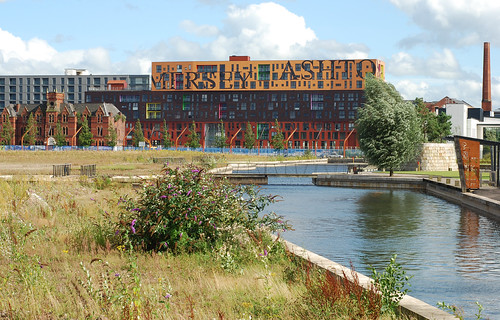
Chips at New Islington in Ancoats, Manchester, England by Alsop Architects. The firm "prepared the strategic framework scheme design for New Islington" and was "commissioned by Urban Splash to design the first of the proposed residential buildings -- Chips -- by the Ashton Canal at New Islington's southern periphery." Check out the developer's handy commercial and residential brochures in PDF form for more information on Chips.
Recently Will Alsop announced he will be leaving his architectural practice to devote his time to painting and to teach at Ryerson University in Toronto, home to his Sharp Centre for Design.
To contribute your Flickr images for consideration, just:
:: Join and add photos to the archidose pool, and/or
:: Tag your photos archidose
Thursday, August 27, 2009
The theme song from the great 1960 film starring Jack Lemmon and Shirley MacLaine is "Jealous Lover" - a song I love dearly and played about 100x on the piano while home this past weekend. The film won five Academy Awards including Best Picture, Best Director, and Best Original Screenplay. Enjoy!
Wednesday, August 26, 2009
Walking around the Nolita/Bowery area a few weeks ago, I passed by some sites to catch up on construction progress. Disappointingly, but not surprisingly, I saw either little or no progress, a clear sign of the troubles plaguing the realms of architecture, construction and development. These sites include:
Sperone Westwater Gallery on the Bowery by Norman Foster
[site photo by archidose; right image source]
Bowery Hotel by FLANK
[site photo by archidose; bottom image source]
Nolita Townhouse by Diller Scofidio + Renfro
[site photo by archidose; right image source]
Some quick research on the web (i.e. Curbed) indicates that Foster's gallery is moving ahead sloooooowly (if uncertainly), FLANK's Bowery developer is in the throws of foreclosure, and the Nolita Townhouse has made zilch progress since last April. All three projects would be welcome additions to the area, so I'm hoping they don't end up like Diller + Scofidio's earlier Slow House, never to get past foundation work:
[Slow House by Diller + Scofidio | image left source, right source]
 I recently came across this amazing all in one kitchen system. Made in Italy by Meneghini, the mini-kitchen fits into a wood or lacuqered cabinet that looks like a piece of furniture. However, it opens up to reveal 2 electric rings, a sink and faucet, a fridge and 2 storage compartments - magic!
 I think a cabinet like this would be great for a mountain or beach cottage - or maybe a city studio apartment in NYC where one doesn't cook at home. I immediately thought of the beach huts that Meg at Pigtown talked about last week as a perfect place for one of these contraptions.
 I especially love this image of the item in wood with a mirrored top. What do you think? Good or bad?
Tuesday, August 25, 2009
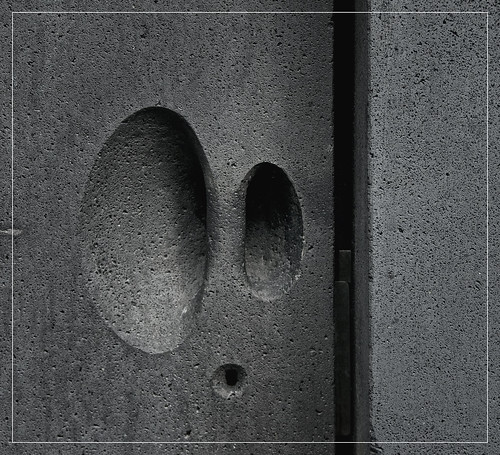
A door handle detail in Gottfried Böhm's Maria in den Trümmern (Chapel of Madonna in the Ruins) in Cologne, Germany, 1950.
To contribute your Flickr images for consideration, just:
:: Join and add photos to the archidose pool, and/or
:: Tag your photos archidose
Sunday, August 23, 2009
My weekly page update:
The Siamese Towers in Santiago, Chile by Alejandro Aravena.
This week's book review is The Miller|Hull Partnership: Public Works by The Miller|Hull Partnership and Pugh + Scarpa: Report 2005 edited by Bruce Q. Lan.
Some unrelated links for your enjoyment:
ReBurbia
The results are in.
urbanSHED
A competition that "challenges the global design community to re-think the current sidewalk shed standard and create a prototype worthy of today's New York City."
Millennium People
A one-month old blog from Jack Self in London. (added to sidebar under blogs::architecture)
caus
The interactive online magazine of the Virginia Tech College of Architecture and Urban Studies. (added to sidebar under blogs::aggregate)
Critique This
"Critique This at the most general level is simply about architecture, but more importantly it is about change. Our mission is to change how the architectural community discusses and views architecture." (added to sidebar under blogs::architecture)
D-Crit
The "new MFA in Design Criticism at the School of Visual Arts, [an] innovative two-year program [that] trains students to research, analyze, and evaluate design and its social and environmental implications."
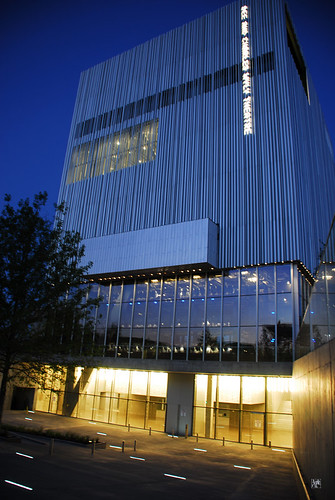
The Dee and Charles Wyly Theatre -- "the world's only vertical theatre" -- in Dallas, Texas by REX | OMA, set to open in October.
To contribute your Flickr images for consideration, just:
:: Join and add photos to the archidose pool, and/or
:: Tag your photos archidose
Saturday, August 22, 2009
The last firm faces looked at hands as an expression of personality, so here we're taking the other extreme and looking right into the eyes of the individuals at Jone Studio. This is one of the freakier presentations of staff that I've come across, the eyes staring right at me...following my every move!
The people page of the firm's site is interactive, not animated like the image above. But the interactivity is limited to seeing each person's eyes and sometimes glasses; no further information is given. The names are already evident at left, so it's just a glimpse that we receive. This is unfortunate, though most likely the office wants to keep things a bit vague, letting the eyes speak. It would probably be fun (or weird) to click on a person's name when speaking to them on the phone, like an old-fashioned video call.
Friday, August 21, 2009
 Unfortunately I don't think we'll be able to make it to Vaux le Vicomte this trip to Paris (next time!) but it's still an awe inspiring site, don't you agree?
The history is fascinating - built by the superintendent of finances to King Louis XIV, he aroused suspicion of stealing funds for this magnificent palace. Plus, you never wanted to outshine the King! He was thrown into prison after a huge estate-warming party, but not before inspiring the king to turn Versailles into the place we know it as today.
Enjoy your own weekend and don't worry about outshining anybody!
Thursday, August 20, 2009
As a means of presenting the people in its office, Marcy Wong Donn Logan Architects favor showing the owners' and various employees' hands instead of faces. While this might seem to deny the strength of the face in expressing personality, for an architect the hand says, and does, a lot. Traditionally the hand is the most important piece between the mind and the drawing, the skillful means of creating a design from ideas. But as can be seen by the 13 hands of 10 people below, the architect's job these days is as much -- or more -- about computers than the physical act of putting pen to paper. Only four of the ten "profiles" do not have a keyboard or mouse in the frame.
Setting aside the effects of technology on the day-to-day activities of architectural production, do these snapshots accurately portray the individuals and what they do? Hard for me to say, but I would wager that (from top to bottom, left to right) Marcy juggles proposals, clients, and lots of other important matters, Donn is the lead designer, Kent pumps CAD, Tai-Ran is a designer, Ketki is a technical architect, Mark drinks a lot of coffee, Justin is the intern, Cari red-lines drawings, Romelo picks up Cari's red lines, and Brandon handles the accounting. Needless to say, since using a keyboard is so common in any profession and architect's roles often overlap, I'll be lucky if I bat 500 on the above guesses.
(via Eye Candy)
 The thing that spurred our trip to Paris in the first place, for both Heather and I, was a passion to visit Versailles. The gardens are especially spectacular and have had many evolutions over the history of the chateau.
  Probably my favorite thing I've seen in pictures so far is the trelliswork that surrounds the Fountain of Enceladus, seen here. It won't be long now!
Taking place September 24-27 in Mad River Valley, Vermont is the Architecture and Design Film Festival, which describes itself as "the first film festival celebrating the creative spirit of architecture and design." Over its four days, "An exciting selection of films, including feature-length films, documentaries and shorts will engage the audience with how architects and designers think, work and create." In addition to the 20+ films to be screened, the fest also includes conversations with filmmakers, architects and designers. The Architecture & Design Film Festival will benefit the Yestermorrow Design/Build School. Yestermorrow inspires students to create a better and more sustainable world by providing an architectural education that integrates design and building into one continuous process.
The current line-up includes these films:
The Greening of Southie
Wednesday, August 19, 2009
This post is stop number three on the "Virtual Book Tour" for David B. Williams's latest book, Stories in Stone: Travels through Urban Geology. Below is my brief description of the book, followed by some commentary from Williams on some contemporary buildings in stone. Check out Clastic Detritus's book review and interview with Williams for stops one and two.
Stories in Stone links the natural and the man-made by tracing building stones used in various parts of the United States to their origin in the earth's crust. The Seattle-based writer takes the reader from Boston to Los Angeles, from "deep time" to the late 1990's, via investigations in brownstone, granite, gneiss, limestone, travertine and other stones. Looking at Brooklyn brownstones, the Bunker Hill Monument, the City Hall-County Building in Chicago, and many more pieces of American architecture, Williams reveals how buildings in stone are naturally, not just metaphorically, rooted in their place.
Unlike now-common claddings like glass and metal, stone allows a piece of architecture to not only express its construction but also the material's making. Rough cuts or polished surfaces exhibit the excavation and workmanship of pieces of stone, but the colors, patterns, fossils and other markings of the material also give clues to how the stone itself was produced millions or, in many cases, billions of years ago. Williams helps the reader decipher these clues, making the experience of seeing and touching buildings in stone that much richer.
By virtue of the subject matter (buildings and cultural history) and the author's background (geology and natural history), the book is non-specialized, geared to a general audience without dumbing down the science at the root of many of Williams's investigations. It reminded me in many ways of John McPhee's Annals of the Former World, yet the urban angle of this book sets it apart from other writings on geology (or so I'm guessing), with its focus on human constructions. I can only hope the book helps readers appreciate the depth found in building stone, a material I believe is in need of a resurgence at a time when smooth and shallow materials predominate in architectural design.
Outside of The Getty Center by Richard Meier and the Amoco Building (originally Standard Oil Building and now Aon Center) in Chicago, most of the buildings Williams discusses at length are more than 100 years old. So for my part of the virtual book tour for Stories in Stone I was curious to find out the author's thoughts on some fairly recent buildings in stone. Below are comments Williams has generously contributed for this blog, his responses to a handful of buildings I e-mailed him recently.
Dominus Winery in Yountville, California by Herzog & de Meuron, 1997:
[image sources: left, top right, bottom right]
The use of a skin of locally quarried basalt allowed the architects to do what I like best in architecture; they created a building that appears to rise organically out of the land. It’s as if the gravel on the side of the road leading to the winery had organized itself and taken over the building. I also like how the architects placed the basalt cobbles and boulders in steel cages, which allows the rocks to nest against each other often with large gaps. This in turn lets light into the building and has the wonderful contradiction of using solid stone to create light.Honan-Allston Branch of Boston Public Library by Machado & Silvetti, 2001:
Basalt is not a rock commonly used in architecture, even though it comprises 40 percent of the Earth’s crust. (Basalt covers most of ocean bottoms and can erupt as extensive flows that cover hundreds of square miles on continents.) Because basalt solidifies from a lava on the surface, the top layers are often peppered with holes, called vesicles or vugs, caused by gas bubbles. The holes generally make basalt a challenging stone to cut into square blocks so those who do use the stone for building generally make a mosaic of stone and mortar. In addition, when basalt cools it can form great columns of material, also challenging to cut into precise shapes.
The steel cages, or gabions, were a brilliant new way to work with basalt as a building stone. Furthermore, it’s as if they have recreated the texture of basalt—solid and holey--within the gabions.
My final comment is that I am pleased again to see the use of local stone for building. Not shipping rock goes a long way to making a smaller global footprint.

[source for images]
Covered in slate, the new Honan-Allston Branch Library alludes to the Boston area’s long history of using slate. The metamorphic rock was quarried on an island in Boston Harbor as early as 1630, and in 1680, the General Court in Boston passed legislation requiring slate roofing. Originally deposited as a fine grained mud, then baked and squeezed into a stone that splits evenly into layers, slate has been used for everything from pool tables to urinals to tombstones to blackboards. (Perhaps to honor the use of slate blackboards, the library could have artists periodically chalk the building in temporary projects.)Getty Villa in Malibu, California by Machado & Silvetti, 2006:
Two types of slate clad the library. The dark gray slate comes from Vermont, whereas Norwegian quarries produced the golden rock skin on the building. Although the Norwegian rock is sold in the U.S. under the name Black Lace Rust Slate, geologists would call it a phyllite or mica schist, indicating a higher grade (greater temperature and pressure) of metamorphism than slate. The mineral biotite gives the rock its shiny sheen and oxidation of iron leads to the various hues of gold. I like how the architects gave the library a dynamic feel by using a stone with so much variation in color and which changes its face depending upon how the light strikes it.
Slate is an interesting building stone because it is generally used only as a two-dimensional material, which emphasizes length and width and not depth. The library exemplifies this use; every slab of slate presents the broad face of the stone. In doing so, it gives the building a lighter feel than in using stone that shows thickness.

[source for images]
This is the one building in the five that I have visited. Like the Getty Museum, the Villa is overwhelming: too much art, too many details to process, too much the feel of a set piece. At times it feels like stepping back into ancient times, except for the people yacking on their cell phones, planes flying over, and digital cameras chiming. But the stunning stone does stand out.Spencer Theater in Alto, New Mexico by Antoine Predock, 1998:
For the Romans of imperial times, there was no better way to signify status than by using colored stone obtained from the lands they had conquered. They acquired buttery marble from Numidia, purple porphyry from Egypt, green serpentine from Greece, and from the island of Chios, stone that resembles beef and bears the name portasanta, a reference to its use as door jambs at St. Peter’s. Each of these appears at the Getty Villa. Technically, most of these aren’t true marble, which geologists define as metamorphosed limestone, but the Romans used the term marble for any hard rock suitable for sculpture or architecture.
The stone is what connects the modern villa to ancient Rome, in part because the many colored marbles are real. They are not modern paintings on a wall or a modern building built to resemble an ancient villa. They are the actual stones of antiquity and they are the main feature that gives the modern Villa its gravitas and true feeling of history.

[image sources: top, bottom]
New Mexico is justifiably called the land of enchantment. Particularly in the sparsely populated, basin-and-range region of the south, the land has a spare and stark beauty, which has long fascinated me. On the typically sunny days, the light is crisp and clean, and emphasizes the geometry of the landscape.Nasher Sculpture Center in Dallas, Texas by Renzo Piano Building Workshop, 2003:
It is clear that architect Antoine Predock understood these qualities when designing the Spencer Theater, outside of Ruidoso. Spare in ornamentation, lacking in color, and with its clear allusions to the surrounding topography, the theater fits the landscape perfectly. As Predock’s web site describes it, “The wedge-like form of the theater suggests a monolithic piece of stone that has forced its way up from beneath the crust of the mesa.” But the building is more than just an appropriate shape.
In cladding the performance center in white Spanish limestone, Predock made an inspired but unusual choice in a state known for its tan to tawny stucco architecture. The white limestone obviously acknowledges the nearby mountain peak Sierra Blanca but it also gives the building a seasonal vibrancy; the theater seems to emerge even more gracefully out of the landscape when winter snows cover the ground. And on those ever present days of crisp and clear light, the white limestone and blue sky perfectly complement each other.

[image sources: left, right]
When I was working on my book, I was told that travertine is the most commonly used building stone in the world. The vast majority of the time, and the way it has been used since the Romans built the Colosseum with it, the travertine is cut perpendicular to its bedding planes, basically analogous to looking at the side of deck of cards, as opposed to the faces. This cutting style gives travertine its well-known resemblance to Swiss cheese.Many thanks to David for contributing the above responses and bringing his book to my attention. Be sure to check out the previous stops on the "virtual book tour" as well as the next one, Friday, at Lyanda Lynn Haupt’s The Tangled Nest.
In contrast, the travertine at the Nasher was cut to expose the face, or bedding of the stone. This creates a far more beautiful and compelling stone, teeming with textures. At the one place where I have seen this face-open cut, the Getty Museum, fossil leaves regularly occur on the panels. The leaves are so well preserved that I could see insect damage and tell if the leaf was right-side up or not. They are some of my favorite stone building panels. (For my travertine chapter, I spent a day in Tivoli, Italy, at the Mariotti family quarry, which supplied the Getty’s travertine. One of the owners told me that few architects chose to use face-cut travertine because they considered it to be Getty architect Richard Meier’s signature stone.)
At the Nasher, architect Renzo Piano made a slight variation on how Meier worked his travertine. Piano left the exterior panels alone, so that the textures and fossils give the building the look of a quarry but on the interior he used polished the panels to focus more on the art and to make the stone better complement the art. I understand why he did this, and suspect he was successful, but with my geological biases, it also saddens me to see this diminishment of the natural beauty of the stone. I guess that’s a difference between an art museum and a natural history museum.
Tuesday, August 18, 2009

 These fabulous views just echo my excitement! Best view in paris from a great store? I'm there!
 I want to thank all of you who have been kind enough to send me your recommendations! They have formed the basis of our trip and I'm so touched that you all took the time to send them!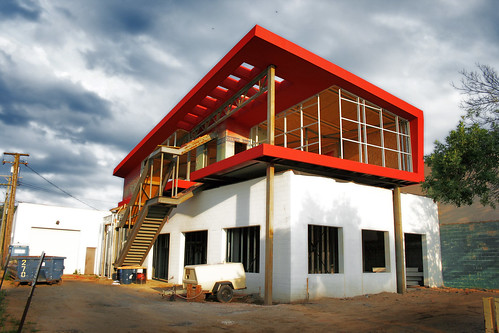
The Flute House in Royal Oak, Michigan by The Think Shop, under construction. For more information check out The Think Shop's flickr sets on the project.
To contribute your Flickr images for consideration, just:
:: Join and add photos to the archidose pool, and/or
:: Tag your photos archidose
Monday, August 17, 2009
 While on Cape Cod last week, I was able to finally stop in the John Derian store in Provincetown.
 I had looked for it last year on my annual beach pilgrimage but couldn't find it! The saleswoman told me they only put up the sign this year -good thing! Still not the easiest place to find, down a small street behind some bushes, but the store did not disappoint with so much to see (in such a small space!).
  Stage right from the doorway were what we come to expect from John Derian, the decoupage! I love the poufs under the table too!
 And more decoupage -I loved this collection of sea-botanicals.
 These charming little tumblers were towards the rear of the store -perfect for a tablesetting at the beach!
 I was so tempted to get one of these ostrich feather dusters and live out my french maid fantasies ( just kidding!!!)
 There was a selection of Cire Trudon candles hiding in the back of the store. I just LOVED the 'trianon' scent - maybe i'll pick one up in Paris next month when Heather and I pay a visit.
 I've always loved these busts that they make, I just wish they came in the muliple scents (like trianon!).
 The bedding was all so cozy, I could have taken a nap right then and there!
 The store was so adorable I could have happily bought everything inside. I had to be content with a decoupage tray of antique stamps and a small notebook to use while in Paris for sketching. I also picked up a nice tote bag with Derian's logo on it for my groceries. If you are in Ptown, it's worth a visit and of course so are the New York stores. Tell them ArchitectDesign sent you (and ignore the looks of utter confusion!).
Sunday, August 16, 2009
My weekly page update:
Messner Mountain Museum in Bozen, Italy by Werner Tscholl.
This week's book review is Five Houses, Ten Details by Edward R. Ford.
Some unrelated links for your enjoyment:
The New New York Photography Corps
The Architectural League and Esto are looking for volunteers "to participate in an important photography project that will document the changing face of New York City since 2001."
otto
"A design eye through which the the international architecture and design community sees itself and everything around it." (added to sidebar under blogs::design+technology)
Sinking Cities
"Sinking Cities is a blog dedicated to the discussion of relevant design issues. Architecture is the focus of Sinking Cities, but all aspects of design and design culture are discussed." (added to sidebar under blogs::architecture)
portland architecture
"A blog about design in the rose city." (added to sidebar under blogs::architecture)
dsgnWrld
In the world of design, vowels are optional. (added to sidebar under blogs::design+technology)
Issue #6 of Triple Canopy is titled "Model Cities," the first of two issues devoted to "examining various forms of and approaches to urbanism, considered in relation to the current economic crisis, from the perspectives of a number of writers, researchers, artist, and architects." The various contributions are presented on a well-designed web page, formatted in a unique yet simple and straightforward manner, a mix between a slideshow and a scroll. The design and interactivity acknowledge the importance of pages in reading, even in a digital format.
Of course one needs good content to accompany the quality design, and that is not a problem here. Some of the projects included in Issue #6, with descriptions by the editors:
:: "Index or Constructed by Way of Experiment," by artist José León Cerrillo, is an Internet-specific, interactive collage of archetypal abstract and architectural forms, drawn from the modernist idiom and from Latin American metropolises, respectively. Departing from Brazilian poet Oswald de Andrade's 1928 "Cannibalist Manifesto," the project effectively cannibalizes the sites and structures of modernism in Mexico City. Cerrillo's work has been shown at PS1's "Greater New York" and at Dispatch Projects in Manhattan and Galería OMR in Mexico City.The second "Urbanisms" issue, again per the editors, "will feature Lucy Raven on a grand Utahan suburb nurtured by coal-mine tailings; Thomas Moran and Rustam Mehta of the VPL Authority on a planned mega-eco-city in the desert Southwest; a new recording from the band Zs; and conversations with architects Teddy Cruz and Kazys Varnelis." I'm looking forward to it.
:: Artist and Detroit transportation scheduler Neil Greenberg’s "Boom, Bust, Burn, Blame: The Story of Fake Omaha," portrays the development of a painstakingly constructed paper-and-ink city–through maps, fabricated municipal reports, agency memos, and other internal documents–in order to explore the real urban planning issues facing American cities. Greenberg's work has been published in Espous magazine and featured at New York's Storefront for Art and Architecture.
:: In 1966, New York's new mayor, John Lindsay, launched a series of far-reaching plans to transform the city. Most of the projects, which aimed to find a middle ground between Robert Moses's grand schemes and Jane Jacobs's emphatic embrace of the neighborhood, were never realized. Ian Volner and Matico Josephson’s densely illustrated essay, "He is Fresh and Everyone Else is Tired," recovers that vision and its lessons for urban development under the Obama administration, drawing on original archival research and conversations with Lindsay-era architects and planners.
:: Joseph Clarke’s "Infrastructure for Souls" traces the parallel histories of the American megachurch and the corporate-organizational complex over the last century, from the Crystal Palace to the General Motors Technical Center to Googleplex, from Charles Spurgeon to Richard Neutra to Rick Warren. Illustrated with a striking series of images juxtaposing ecclesiastical and office buildings.
:: In "The City that Built Itself," Joshua Bauchner writes about and photographs a Caracas slum where residents have turned utopian modernism on its head, transforming a fifty-year-old superblock housing project into the locus of sprawling improvised developments.
Saturday, August 15, 2009
Here are some photos of the CCTV and TVCC buildings in Beijing, China by OMA. Photographs and commentary are by rudenoon.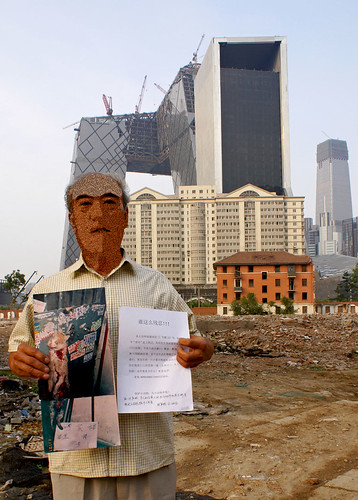
rudenoon's description for the above photo:
"This man lived in Hu Jia Lou Xi, Chaoyang District, Beijing, CN, and was one of the few remaining residents who resisted official displacement. He displays a court notice and two photos of cats that had been killed and wired to resisters' doors. The man's face has obviously been distorted to protect his identity. The CCTV (China Central Television) Headquarters project and China World Trade Center Phase 3 are in the background.
Residents of the 15-story apartment building closest to the TVCC (shown above before the conflagration and ensuing scandal) staged a protest on Monday morning August 10, 2009 after being publicly threatened with 'forced relocation' in a CCTV statement published in the Beijing Daily, a city newspaper.
This photo was taken on June 4, 2008, 6:40 AM, and it, along with more on the recent protest, is further described in my blog post A Short Eviction Story."
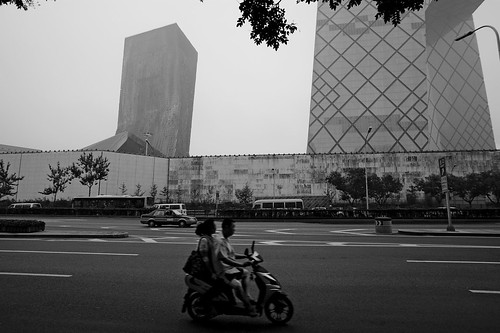
[August 8, 2009, 6:57 AM]
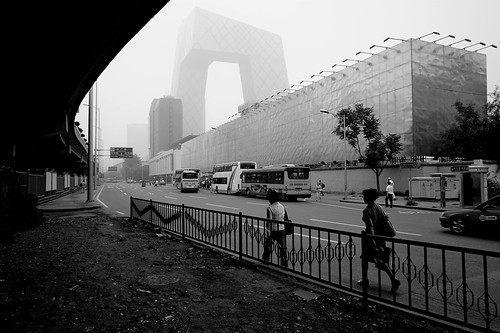
[August 8, 2009, 7:12 AM]
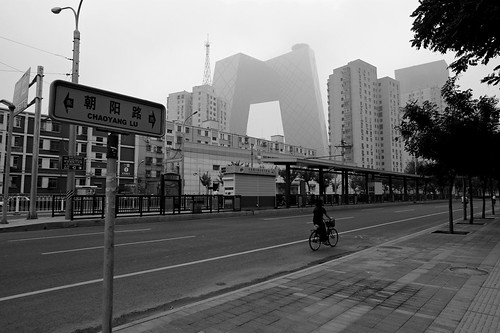
[August 8, 2009, 7:37 AM]
For more on the CCTV HQ project see rudenoon's blog post A Year and an Hour On.
To contribute your Flickr images for consideration, just:
:: Join and add photos to the archidose pool, and/or
:: Tag your photos archidose
