Wednesday, September 30, 2009
Here are a couple announcements for fundraisers, one for a non-profit organization in New York and the other an art installation in Detroit.
Our good friends at the Design Trust for Public Space will be holding their Annual Benefit on Thursday, November 5th at Ogilvy & Mather's offices in The Chocolate Factory, 636 11th Avenue in Manhattan. The benefit will feature "one-of-a-kind shelters created exclusively for the Design Trust by prominent architects, designers and artists on the theme of 'Nest: Creative Construction for any Living Creature.'" The impressive list of names creating shelters includes Christo & Jeanne-Claude, Hariri & Hariri Architecture, Lewis.Tsurumaki.Lewis Architects, Slade Architecture, Snohetta,Tod Williams Billie Tsien Architects and WXY architecture.
Ice House Detroit is an installation developed by photographer Gregory Holm and architect Matthew Radune. It "involves the acquisition and recontextualization of one of the 80,000 abandoned houses in the city. The house will be sprayed with water in subzero temperatures, gradually building up layers of ice over the course of several days or weeks." Photographs, a book, and a film will document the house, available to those who pledge, depending on the amount given. Holm and Radune are aiming to raise $11,000 by December 16 to make the project happen.
 Another folly built on the grounds of the Petit Trianon for Marie Antoinette by Richard Mique & Hubert Robert is the Temple of Love.
 This temple sits on the opposite side of the house as the older French Pavilion and houses a statue of cupid.
 It overlooks a small stream that runs up to the Petit Trianon.
 Inspired by antiquity, the columns sport Corinthian caps.....
 and a coffered dome.
 It sits out in the English landscape. Here it is viewed from the side of the house.
 The temple rests on a small island reached by a small bridge. I loved that the side of the bridge acted as a planter for wildflowers.
 The Petit Trianon, finally making its' debut as seen from the Temple of Love.
 Marie Antoinette had the Temple of Love built within view of her bed in her bedroom - can it be any more poetic than that? Do we think she had Count Fersen in mind or her husband, Louis XVI?
Monday, September 28, 2009
Flipping through October's Architectural Digest, "The Architecture Issue," a couple advertisements stood out, each using architecture and architects to sell cars.
The first is a two-page spread for Lexus, its HS Hybrid sitting in front of a Richard Meier sketch of his "much-anticipated Italcementi Innovation and Technology Central Laboratory" in northern Italy. The fairly ho-hum sketch is accompanied by text that boasts the lab "will be built of TX Active concrete that will 'eat' smog and significantly reduce pollution caused by car emissions and industrial activities." Not surprisingly the pollution-mitigating cement was developed by Italcementi and tried out on Meier's Jubilee Church in Rome. The ad's text further states that the other features of Meier's building (insulated low-e glass, geothermal, solar energy systems) will supposedly "provide close to total energy self-sufficiency."
The second ad is one of those "special advertising sections" laid out like a magazine feature, fooling us into reading the content as if it didn't exist solely to sell a product. Across four pages the reader is shown the winners of Maserati's 2009 "nationwide call for entries of garages in which a Maserati might feel at home." Most of the photos are of the existing garage winner, Holger Schubert of Archisis (the other winner, in the conceptual category is shown in the gray box at bottom right). The 1,200sf (111sm) garage is the first of five for the L.A. architect's canyonside residence; it literally looks like a home for the car. A bridge gives access to the glass-walled garage. Features inside include radiant concrete floors, mechanically operated window screens, a library with homasote walls, some designer furniture and a ramp that raises six inches to allow Schubert to pull out of the garage without starting the engine. The top-right image shows that not only does the architect give the car a view he also gives onlookers a view of his car.
That architecture and architects are being used to sell cars does not surprise me; it is something I documented in 2005. Nor am I taken aback that it is done in these manners. Design and its relationships to the environment, in the first case, and luxury, in the second, are shared by both the building and car industries. And, while further differences between the two ads include the celebrity stature of one architect and the relative lack of name recognition of the other, they share a certain optimism about the future of architecture and cars. Sustainability, creativity and a drive (pardon the pun) to improve our situation links these two realms. Now if only architects could be paired up in advertising with bicycles or public transportation.
 On the grounds of the Petit Trianon was another charming little pavilion. The Belvedere was built for Marie Antoinette by her architect Richard Mique and the painter Hubert Robert as a highlight in her English style garden.
 Built on a hill on an artificial island, the Belvedere is circled by a terrace with charming sphinx standing guard. It has a commanding view of the English gardens with the Petit Trianon resting nearby, hidden by trees.
 The interior is painted with murals and flooded with light all day long.
 What a charming room to have lunch in!
 The decoration continues up to the ceiling.
 As you can see the Belevedere is a private place as its' small size demands.
  Set as a folly in a 'natural' landscape, the building acts as a human foil.
 We admittedly spent a good 30 minutes here just relaxing in the sun before continuing our tour of the estate. Hope you enjoyed this folly as much as we did!
 While at the bookthing this past weekend, I picked up a copy of House & Garden magazine from March of 1993. Hard to believe this was 16 years ago now and a lot of the magazine, especially the ads, are incredibly dated. However, one article that withstood the test of time is about William Sofield and Thomas O'Brien.
 The article features examples of their work from both of their own homes, office and gallery. The gallery wall (seen at the top of the post) could easily be in a magazine today.
 I loved this image from the Aero gallery.
 This is the living room of Sofield. Interesting side note -he's quite handy and restored the plaster ceiling himself!
 A tablescape by Sofield. The cheval glass was designed by Ogden Codman for the Breakers mansion in Newport, RI.
 The spare and symmetrical treatment of the fireplace will never go out of style.
 The only space which is a bit dated but none the less cozy is the guest bedroom of O'Brien.
Sunday, September 27, 2009
My weekly page update:
Three Educational Buildings in New York, Texas and Louisiana.
This week's book review is On Architecture by Fred Rush.
Some unrelated links for your enjoyment:
polis
An offshoot of the dearly departed Where. (added to sidebar under blogs::urban)
Reimagining Boston's stalled projects
"The Globe's Casey Ross asked some local artists and architects to reimagine [some] stalled projects and come up with ideas to make them part of the city's culture again."
MAP
"MAP (Manual of Architectural Possibilities) is a publication of research and visions; research into territories, which can be concrete or abstract, but always put into question."
Swiss by Design
A podcast interview with Peter Zumthor, from World Radio Switzerland.
Pendulum Plane: Oyler Wu Collaborative by Oyler Wu Collaborative, edited by Todd Gannon
L. A. Forum for Architecture and Urban Design, 2009
Paperback, 96 pages
At a 2008 panel discussion on The Future of Architectural Publishing, one response to a question from an audience member, "What do you know doesn't work?," was "books on individual buildings." Luckily another one of the panelists countered this position, pointing out the past successes of some book-length case studies on single buildings. I say luckily because I'm a big fan of books that document, present, analyze and critique one building; I agree that they can work well. A magazine article, a portion of a monograph, or a blog post are comparatively lacking in respect when compared to the huge effort of designing and constructing a building. In that sense, this pamphlet-size case study for Oyler Wu Collaborative's small-scale storefront intervention for the LA Forum's new headquarters on Hollywood Boulevard is just the right size: small like the project itself, but big enough to convey the multitude of ideas present in the project.
Architects Dwayne Oyler and Jenny Wu won a 2008 two-stage competition with a proposal that falls somewhere between the spatial fullness and serene bouyancy of the other two finalists, F-lab and Kuth/Ranieri, according to Mohamed Sharif's introduction. The winning design proposes an intervention that inhabits the ceiling and acts as an armature for exhibition displays, important given that the Hollywood Boulevard space is shared with the Woodbury School of Architecture. This occurs via a hinging of the aluminum pipe structure, one of the many aspects of the design and construction documented here with sketches, models, renderings, architectural drawings, and photographs. A conversation between Wes Jones and Oyler and Wu, and an essay by Todd Gannon round out the information packed into the book's 96 pages. Gannon's essay is particularly insightful, situating the design within the historical de-emphasis of the ceiling in favor of vertical surfaces, walls of glass and other materials.
The complex, alien-like intervention appears to be generated within a computer environment, especially given the renderings that accompanied the drawings in the competition boards. But the models and sketches complicate this assumption, one that is deflated in the conversation with Wes Jones, where Oyler and Wu situate the physical models above the virtual ones in terms of importance in shaping the design. Here the computer's presence is in realizing the armature's complex but repeating forms, whose bent corners simplify construction (fewer complicated and time-consuming aluminum welds) but also give the piece its particular presence: a dense overlay of lines and curves, ever-changing and challenging our preconceptions about what an architectural intervention should be.
The intervention fits into Oyler Wu's portfolio alongside two other aluminum installations (one at SCI-Arc, where they both teach, and one at Materials & Applications) that predate Pendulum Plane. These investigations activate their respective environments in similar yet unique ways, using structure to create a canopy, stairs and a ceiling, architectural elements typically constructed of planar materials. The most recent design throws the kinetic into the mix, extending the effects of the previous projects but making one hope this isn't the last we've seen of Oyler Wu's aluminum experiments.
Saturday, September 26, 2009
Friday, September 25, 2009
 I hope you enjoy our first fall weekend. Looks like we'll have pretty nice weather here in DC: damp and cool (just how I like it!). Thats how the weather was on our first 3 days in Paris. Above; a square in St. Germain by one of the Flamants we visited. I just wish DC was as beautiful!
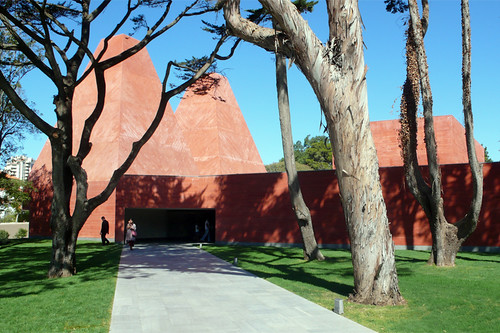
Cascais, Casa das Histórias e Desenhos Paula Rego. Eduardo Souto de Moura, originally uploaded by z.z.
Casa das Histórias e Desenhos Paula Rego in Cascais, Portugal by Eduardo Souto de Moura, 2008.
To contribute your Flickr images for consideration, just:
:: Join and add photos to the archidose pool, and/or
:: Tag your photos archidose
Thursday, September 24, 2009
 My favorite housewares store I have ever visited is Flamant - numerous locations throughout Paris.

 I could move right in - literally! The entire store is set up as vignettes in a home.
 I bought some amazing candlesticks here that I will share soon with a tablesetting :-)
 The great thing about Europe - lit candles in stores! Everywhere! Shopping by candlelight -what could be more charming?
 I loved this desk.
 And a La Cornue stove -my dream!
 Red and Grey, black and white tended to be the color schemes -with a lot of natural light woods and linen.
 People just made themselves at home.
 Which is better, the chair or the bookcase? I'll take both, please.
 Loved these dark walls with the natural oak flooring.
 Doesn't this look like someone's apartment?
 I just loved this little desk back in the nook.
 Heather will hate the comparison (I had one for every store we went into), but I think this store is like a much larger William Sonoma Home. I love that store too (and we need one in DC!)
 They have the lighting down. It's all about the lighting.


 Visit Flamant if you ever get a chance. You won't walk away empty handed!
