Saturday, October 31, 2009
On Wednesday evening I attended a party at Vitra celebrating the publication of a long overdue monograph on architect Jean Tschumi, written by Jacques Gubler and published by Skira. Jean Tschumi: Architecture at Full Scale documents the brief career of the Swiss architect who eschewed his Beaux Arts training in favor of "the polemical field of modernity and its technological expression." In the US, the name Tschumi is more well known prefaced by Bernard, rather than Jean, who died in 1962 at the age of 57, when his son was only 18 years old. His early death may have cut his architectural career short, but the quality of the architecture that he produced is evidenced in the pages of this monograph and in the Archizoom exhibition last year, curated also by Gubler.
I'm especially taken by the image on the party invitation of the Aula de Cèdres, a conference center and auditorium at HEP Lausanne:
On Wednesday Gubler spoke of Tschumi's architecture relative to color (embraced by the architect, but rarely captured in documentation of buildings) and scale, referring to the book's subtitle and the architect's consideration of design from furniture to the city. The book offers an in-depth exploration of Tschumi's career, which includes a number of office headquarters, for Nestlé, La Mutuelle Vaudoise, and the World Health Organization. (This blog post at New Switzerland gives a decent overview of the qualities of Jean's architecture.)
One is tempted to break down how the father's architecture influenced Bernard Tschumi's, though if an influence on the latter is evident, it is in the year's since his father's passing. Some brief words on Wednesday by the architect of the new Acropolis Museum pointed to little discussion between the two regarding architecture. In fact Bernard admits that he didn't decide to pursue architecture until a trip to Chicago, only a few weeks before his father died. But with time to study his father's buildings, and a role in Architecture at Full Scale, it would be difficult not to find Jean's influence on his son.
[new Acropolis Museum | image source]
Looking at the two buildings shown above, I would say the influence of Jean on Bernard happens primarily with thinking about site. The above clearly illustrates how the new Acropolis Museum's top relates to the distant Parthenon, while the lower floor contends with the ruins preserved below. In between, the museum is all about movement and the clarity of the exhibition, but it can be seen as the byproduct of contending with the site below and distant. The elder Tschumi's HEP building skillfully addresses the site's topography (as can be seen here) and adjacent buildings, standing out formally but fitting into the multi-faceted landscape.
In the Wednesday-night party's introduction by Nina Rappaport, Chair of DOCOMOMO-New York/Tristate, the preservation of Jean Tschumi's architecture in Switzerland was commended, an unspoken difference between an appreciation of Modernism's gems and the demolition of the same in part or in full an ocean away. The US chapter of DOCOMOMO (international working party for DOcumentation and COnservation of building sites and neighborhoods of the MOdern MOvement) includes ten regional chapters (all tolled the international DOCOMOMO is 53 chapters strong), but fights for preservation seem to be lost more often than won.
While this fact points to a limited appreciation in this country for architecture produced in the middle of last century, I can't help but wonder if this situation is more about ideology than taste. Modernism was predicated on progress and responses to the changes sweeping across the developed world from industrialization and world wars, so the preservation of the movement's buildings seems anithetical to their origin. That people equate modern architecture with the tabula rasa clearing of neighborhoods, towards the erection of towers in the park in that time does not help matters.
A couple issues further complicate matters: how many modern buildings were not built with the longevity of buildings centuries before; the open plans and platonic forms of modernism did not turn out to be as flexible as envisioned. These point to the necessity of preservation less than 75 years after many buildings of the era were completed and the creativity needed by architects to propose and carry out the adaptive reuse of modernist structures. I think the latter is key in efforts to preserve modern architecture, especially when faced with opponents arguing that demolition and new construction is cheaper and therefore better. The fact that many modern buildings are ingrained and important elements in their neighborhoods (ironically, like the older buildings many modern structures replaced) is perhaps the strongest argument for DOCOMOMO's continued relevance today.
 My favorite time of year - crisp air and beautiful leaves. This image of the Georgetown C&O canal near my office. Enjoy your weekend!
Friday, October 30, 2009
 My new favorite place to hang out in DC is the bar at the newly renovated St. Regis hotel! Recently renovated by Sills Huniford, the space is truly amazing.
  The historic hotel has been beautifully renovated but updated with modern furnishings and light fixtures that are easily reversable so no fears of the space 'dating'.
 They have some creative cocktails and probably the best sangria I've ever had (the fruit is strained out so you don't get those nasty bits in your teeth!)
 But it's the atmosphere that truly gets me, especially at night. Ebony paneling, an antique ceiling and tall windows.
 We had our local dc design bloggers happy hour here a few weeks ago and now I'm hooked! If you're ever in dc check out the hotel!
Thursday, October 29, 2009
Here are a couple recent buildings in London photographed by z.z.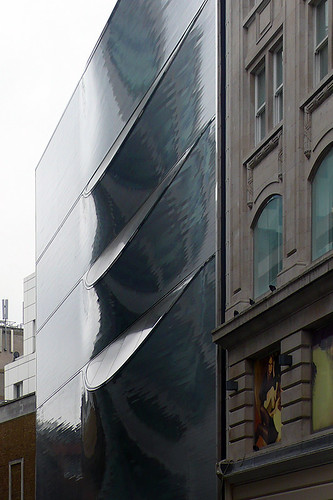
[10 Hills Place by by Amanda Levete Architects, 2009]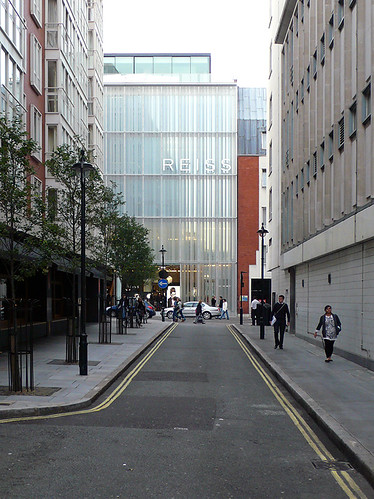

[Reiss HQ by Squire and Partners, 2008]
To contribute your Flickr images for consideration, just:
:: Join and add photos to the archidose pool, and/or
:: Tag your photos archidose
Wednesday, October 28, 2009
Earlier today I was speaking with my publisher about the impact of digital technology on good-old-fashioned books, after which I saw the Sentient City exhibition. Needless to say I was feeling awash in the technology that is changing the way we absorb information, interact with each other, and encounter the city. So I felt a tinge of sentimentality when I came across The Hand of the Architect, a "limited edition Moleskine book filled with [378] drawings from 110 internationally renowned architects." Flipping through the pages, for a few moments the rush of the digital (if only in my head) gave way to a calm and slowness that hand drawings seem to embody.
[The Hand of the Architect | image source]
Of course hand sketches in their various media (graphite, ink, wash, crayon, marker, etc.) are good for much more than perspective in today's get-carried-away-with-technology world. They convey thoughts and ideas in particular ways that are much freer than any digital counterpart. Unencumbered by the need to learn software, the hand-brain connection allows the latter to figure things out as the former touches pen (or brush or quill or whatever) to paper. In other words, making a drawing by hand forces one to confront what one is drawing, thinking and understanding what each line, stroke, dot, field of color describes.
Books like this one from Moleskine are timely reminders of how digital tools can't replace all traditional ones, particularly pen and paper. For example, the research for my book is documented via a mix of spreadsheets, digital map overlays, digital photos, and a notebook (a Muji, sorry Moleskine). The last is a collage of notes, sketches, and pasted images, an ideal canvas for me for jotting down ideas at home, on the train, in front of a building, wherever I may be. But my research cannot exist without the digital components, and I'd also have a hard time limiting myself to just the bytes and bits.
So it should not come as a surprise that in addition to the "glimpse into the sketchbooks of visionaries like Michael Graves, Zaha Hadid, Piero Lissoni, Kengo Kumo, Mario Botta, Tadao Ando, and many more" is a "companion special edition blank journal" for budding architects and others to fill up. or
or 
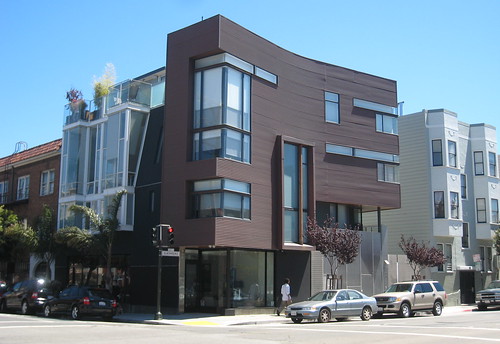
Guerrero Street Mixed-Use Development in San Francisco, California by Kennerly Architecture & Planning.
To contribute your Flickr images for consideration, just:
:: Join and add photos to the archidose pool, and/or
:: Tag your photos archidose
Tuesday, October 27, 2009

 Images shown are from his website of one of my favorite projects he has completed, a townhouse in Eaton Square. Michael showed a great deal of images: both published and unpublished, older and recent as well as a brief rundown of his many product lines. While talking about the bedroom shown above, probably one of my top favorite published bedroom images, Michael mentioned his philosophy of a bedroom as 'a crib' or a cozy retreat. He is a fan of patterned walls and beds nestled against the wall.
 Michael quickly broke down his design philosphy in a very clever way and you can see examples of this throughout all his work: the mixture of 2 ideas (often opposing) that bring out the best features of both. Whether it be mostly modern with an antique painting thrown in or English country with a few pieces from Marrakesh, this tension is where the interest lies in his work- the true definition of an eclectic interior! He believes the discord "brings you into the moment by its contrast".
  At the same time, Michael is concerned with balance. He never wants a room to be 'too simple, too fancy, too cluttered', etc. In a very formal dining room he'll throw in a sisal rug in contrast to a patterned or scenic wallpaper.
 Another of the mainstays of his work is investing in quality, classic pieces. He mentioned in his own homes (as he is always moving) keeping the same couches for decades and uphostering them when they get a bit shabby. I noticed throughout many of his own houses that he showed the same pieces kept showing up. If you love something, you will always make it work: Stay away from the overly trendy and never start from scratch!
 Michael said that being an interior designer is one of the most personal and private fields you can ever go into. You get to know your clients very intimately and you should never betray their trust, hence the 'don't ask don't tell' policy on the White House! He did however mention that his work there was to 'highlight the best of America' and not neccesarily the traditions of the White House.
 Michael easily (and often) admited to being proudly high maintenance. He said "I'm not the easiest decorator to have" because he wants to challenge his clients to be invested in their houses. He wants them to think about their choices and for their spaces to be true reflections of not just Michael's taste, but their own lives. He claims all of his projects are incredibly individualistic and won't ever take on a client who merely wants a copy of one of his previous jobs.
 I hope you all enjoyed these little tidbits I gleamed from the lecture; it was an entertaining and charming way to spend a rainy evening! All quotes are in italics.
Since world-architects.com is the media partner for the Storefront for Art and Architecture and Pike Loop (featured previously) I was able to get a sneak peek last night at the completed installation, snapping the photos below. Tonight at 7pm is the inauguration of Pike Loop, which will be in place at Pike Street between Division Street and East Broadway until the middle of January, 2010. The exhibition on the installation's architects, Gramazio & Kohler, is on display at the Storefront until November 14, 2009.
[Pike Loop installation | photo by archidose]
[Pike Loop installation | photo by archidose]
[Pike Loop installation | photo by archidose]
[Pike Loop installation | photo by archidose]
[Pike Loop installation | photo by archidose]
[Pike Loop installation | photo by archidose]
[Pike Loop installation | photo by archidose]
Monday, October 26, 2009
 When it rains, it pours. First my HVAC broke, then my refrigerator (beware of GE monogram), I broke my favorite teapot, a pair of sunglasses split in half this weekend and then today my dvd player died after I was sick for a week. Better days must be ahead.
 When one door closes, another opens: here's hoping it's true. I've already rediscovered a new favorite teapot in my kitchen cupboards! Back to our usually scheduled programming tomorrow.
My weekly page update:
Grid House in Philadelphia, Pennsylvania by Moto Designshop.
This week's book review is Subnature: Architecture's Other Environments by David Gissen.
Some unrelated links for your enjoyment:
Abitare
The Italian magazine's web page is redesigned. (linked in sidebar under architectural links::publications)
Architectural Record
Another redesigned web site for an architecture magazine. (linked in sidebar under architectural links::publications)
AJ Notebook
"Design inspiration. Selected by you, curated by the Architect's Journal." (added to sidebar under blogs::aggregate)
Buildings: The Plan
Ian Volner's contributions for The Faster Times, "a new type of newspaper for a new type of world." (added to sidebar under architctural links::news)
Buildings: The Section
Eva Hagberg's contributions for The Faster Times, "a new type of newspaper for a new type of world." (added to sidebar under architctural links::news)
Friday, October 23, 2009
 In honor of the miniature interiors that Peak of Chic blogged about today, I thought I would show you the set designs displayed in the library of the Garnier Opera House in Paris.
 The Paris Opera House is also known as the Palais Garnier, after the architect who designed this magnificent structure, Charles Garnier. Designed in neo-baroque style, the opera was completed in 1875 and is truly one of the most amazing places I have ever visited. I can't wait to show you more of it at a later date. However -onto the miniature set designs!
 These small boxes line part of the library you can see above and aren't more than 12 inches high and are lit from behind. I'll never know what it is about miniatures that are so fascinating. Can't you see yourself viewing an opera in one of these?
 This seems to have been part of the tour of the opera that visitors tend to linger at the longest! Everyone loves a miniature: I suppose it brings out the child in all of us.


 At the end of the library is this really beautiful painting, definitely not in miniature as the ballerina is shown at full scale!
Here are a number of prefab residential projects in Minnesota (unless noted otherwise) by Hive Modular. Check out their PDF catalog (10mb) for more information on the different lines. All photographs are by HiveModular.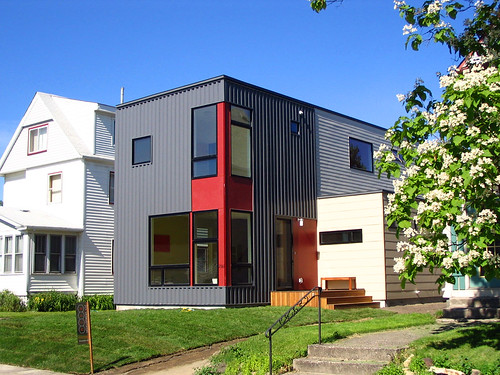
[B Line Medium 001 in Minneapolis | Flickr project set]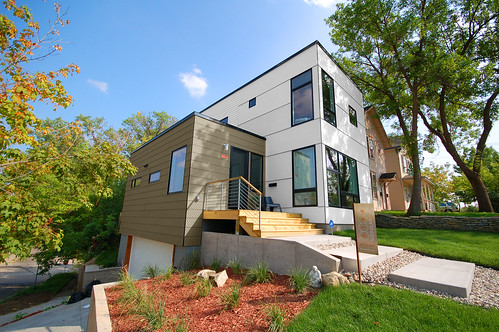
[B Line Medium 002 in St. Paul | Flickr project set]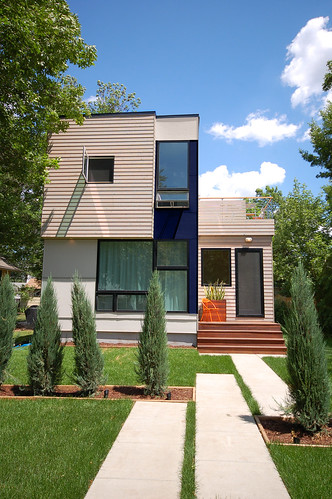
[B Line Medium 003 in Minneapolis | Flickr project set]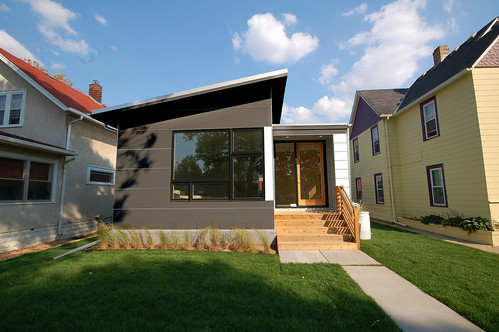
[B-Line Small 002 in Minneapolis | Flickr project set]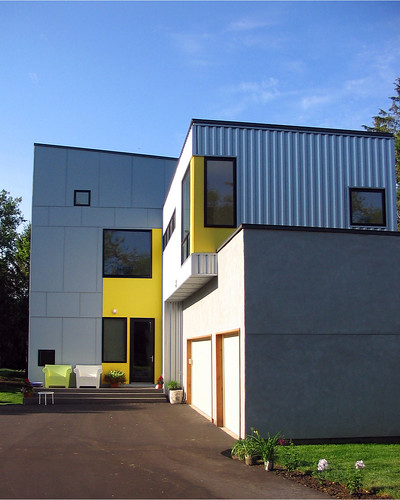
[X-Line 001 in New Brighton | Flickr project set]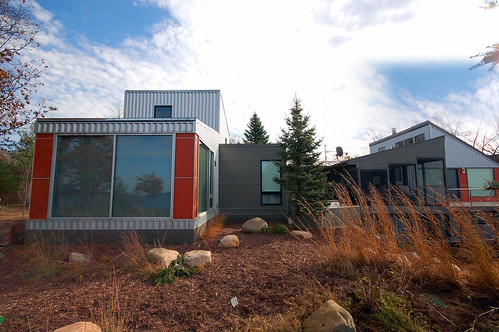
[X-Line 002 in Chippewa Falls, Wisconsin | Flickr project set]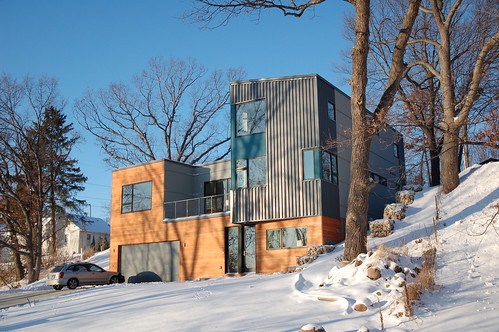
[X-Line 002 in Vadnais Heights | Flickr project set]
To contribute your Flickr images for consideration, just:
:: Join and add photos to the archidose pool, and/or
:: Tag your photos archidose


