Sunday, January 31, 2010
My weekly page update:
This week's dose features Hill Hut in Stockholm, Sweden by visiondivision:
The featured past dose is House for a Musician in Scharans, Switzerland by Valerio Olgiati:
This week's book review is Architecture of Change 2: Sustainability and Humanity in the Built Environment edited by Kristin Feireiss and Lukas Feireiss:
Some unrelated links for your enjoyment:
Architectour.net
"International contemporary architecture database." (added to sidebar under architectural links::guides)
Chicago Architecture: A Critical Guide by Edward Keegan
"THE iPhone App for better understanding and visiting the buildings of the America's First City for Architecture." (Available at iTunes.)
Drawing Ideas in Perspective
An essay by Alexander Severin on "the absence of spatial representation in architectural discourse."
:output award
An "international student award for young talents in design and architecture." Deadline is February 15.
Unhappy HipstersCommentary on photography in Dwell Magazine, subtitled, "It's lonely in the modern world." (Thanks HB!)
Decades from now 2009 may be seen as the year that vertical farming started to take hold. Time magazine named vertical farming one of last year's 50 best inventions. Proposals seemed to arrive almost weekly. And whole blogs -- or parts thereof -- are devoting themselves to the subject.
The push for more sustainable and less land-devouring, transportation-heavy, soil-depleting, ground-water-polluting practices of agriculture ranges from systems that fit inside buildings to skyscrapers devoted in their entirety to food production. The former is more immediate and realistic, while the latter's proposals are still in the realm of ideas and fantasy, at least on the large scale many envision them. Spurred by a recent Scientific American article -- penned by a Dickson Despommier, a vocal proponent of vertical farming and the president of the Vertical Farm Project -- I explored to see what forms these hypothetical vertical farms may take, and how they integrate with other functions to create a true urban agriculture, not just monocultural functionalism akin to agribusiness supplanted to the city.
[Kenn Brown Mondolithic Studios | image source]
The Scientific American article uses the above illustration -- a vertical farming campus of sorts -- to optimistically portray the possibilities, in terms of form and its relationship to the city it serves. The rendering shows not only the crops behind glass walls but also the vast amounts of infrastructure required for the functioning of such buildings, particularly power generation and water supply/reuse. Architecturally, considerations of massing, placement and solar orientation are more important than the design of the exterior envelope. The importance of sunlight even in urban vertical farming points to controls for retaining solar exposure in regards to nearby developments. This points to brownfield locations and others outside the city center as well as segregated zoning.
[WORKac for New York Magazine | image source]
A pre-2009 hypothetical proposal by Work Architecture Company for a site in SoHo terraced crops and other green uses in front of migrant housing, all above a farmer's market. Commissioned by New York Magazine, this sketch thoughtfully combines two important aspects of agricultural production while also acknowledging the surrounding neighborhood with a golf course, market and large-scale sculpture on the plaza. Hardly serious in execution but very much so in its programmatic details.
[Agro Housing by Knafo Klimor Architects | image source | via Veg.itecture]
Knafo Klimor Architects' winning entry for the Living Steel Competition also combines vertical farming with housing, the latter wrapped in a C-shape around the former. Designed for a location in China, the design resembles a community garden extruded twelve stories. I like this idea because it treats food production as a commons for personal consumption, though I doubt it could sustain all people living in the building; additional food (even ignoring meats, dairy, and other types of foods not able to be "grown" vertically) will need to be obtained from elsewhere to supplement what's grown locally.
[Designs for vertical farming | image source]
Inhabitat collects some of the more far-fetched proposals for dealing with an anticipated 3 billion more inhabitants on earth by 2050. The Inhabitat post discusses an op-ed New York Times piece by Mr. Despommier, who seems to be directing much of the discussion around large-scale vertical farming. I think proposals aligned with his thinking are many years off and small-scale urban farming should be nurtured as much, if not more than larger projects. Rooftops, windows, community gardens and other urban "sites" are ripe for exploitation for growing food, or at least for experimenting to determine the best ways to grow in such a setting, and as a way to shape future zoning laws and building codes towards embracing urban farming. Of course small-scale food production is already being done, but not as widely as it should be. The large-scale fantasies above might just have the benefit of increasing the implementation of small-scale urban farming as large-scale alternatives are designed and debated.
Friday, January 29, 2010
 In my second in-depth look at the Petit Trianon, we'll continue to explore the ground floor.
 The billiard's room is adjacent to the grand stairhall and in the time when the trianon was first built, was intended for the male guests of Madame de Pompadour. King Louis XV himself supplied an ornate billiards table for the use of his guests: You see the room on the floorplan below in blue.
 However, when Marie Antoinette was given the PT for her own private use, she had Louis XV's pool table moved up to the main level (1784). She then gave the billiards room over to the officers of the guard (who were stationed across the stairhall) with a more ordinary billiards table, probably similiar to the one found there now. A kind gesture on her part in my opinion, as it gave additional space to her guards that also occupied a prime corner room with views of the garden.
 The room has a bust of Marie Antoinette on the mantel, beautiful herringbone floors and 'high' painted paneling. The jib door connects to the warming room, a sort of butler's pantry, where some of Marie Antoinette's personal china is displayed today.
 This detail shot of a door shows how beautiful the gilded bronze hardware is. I especially love this shade of green paint.
 Across the stairhall from the billiards room is the guards room, seen on the floor plan above in the darker green shade. It was inexpensively finished with plaster walls fauxed to look like stone and wood cabinets with fauxed-marble tops. The window and door in this room look out into the main entry court. The room would have been filled with cots, tables and chairs for the guards as they would spend most of their time here; I can only imagine how boring that would be!
 On the opposite side of the guards room from the grand stairhall (seen in the light green on the floorplan) is an unfinished stone passageway. This sits under the main terrace off the dining room on the floor above. It provided passage from the service courtyard, servants lodgings and carriage house with the kitchens behind the grand stair.
 Through this roughly finished space, servants could pass un-detected from the kitchens to their own dwellings without disturbing Marie Antoinette and her guests in the gardens. The guards would also use this space and could patrol who was coming in and out of the kitchens.
 I love these hewn limestone walls and exposed timber beams. This unfinished roughness was the complete opposite look of the very finished spaces found elsewhere in the Petit Trianon, but one that is very popular and copied today. Join me next week when we explore the main level occupied by Marie Antoinette.
Here are a couple views, outside and inside, of the Madinat Al Zahara Museum and Foundation Offices in Córdoba, Spain by Nieto Sobejano Arquitectos. Photographs are by pajaritos13.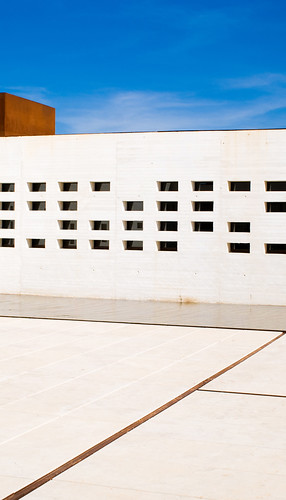
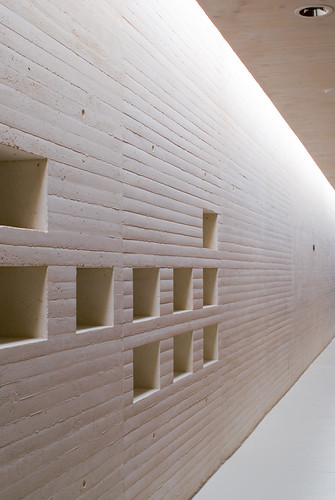
To contribute your Flickr images for consideration, just:
:: Join and add photos to the archidose pool, and/or
:: Tag your photos archidose
Thursday, January 28, 2010
"Architects have more to offer their clients and society than they realize. Integrating design morphology, material science, and environmental sustainability will undoubtedly inform everyone what is possible or achievable in the built environment, in a manner not previously seen. A focus on architectural science (distinct from building science) must equal our overwhelming obsession with form. It must become the foundation by which to certify a new architectural expertise -- comparable in breadth and scope to medical research. The National Science Foundation should be the logical choice to fund such research but -- incredibly -- it does not recognize architecture as a science! We must demand that our representative organizations, such as the AIA, lobby to change this.- "The Digital Design Ecosystem: Towards a Pre-Rational Architecture" by Paul Selestsky (senior manager of digital design in SOM's New York office) in Provisional: Emerging Modes of Architectural Practice USA, edited by Elite Kedan, F. Jonathan Dreyfous, Craig Mutter (Princeton Architectural Press, 2009, pp. 44-45)
Today's broad societal concerns -- global warming, greenhouse gases, resource depletion -- will focus greater public attention than ever before toward architects for answers and innovative solutions. Should they fail, such attention will quickly be redirected elsewhere. The US Green Building Council, Architecture 2030, and Architecture for Humanity all raised broad public awareness on these issues well before any of the professional organizations did. This is not a coincidence but a wake-up call. Talking about green design can only go so far. Metrics derived from controlled testing -- automobile fuel mileage or appliance energy ratings, for example -- enable those with ideas to speak above the fray. Those who now seek government-funded building programs but fail to address the opportunity for digital design process change will have missed the point."
ArchNewsNow links to an article at the Center for an Urban Future at the Center for an Urban Future, which leads me to their sister organization City Limits magazine, where I find in their classifieds that design-guru Edward Tufte is in need of some gallery space in Manhattan.
I'm wont to not only wonder about what fits his description (a Chelsea gallery, a vacant retail storefront) but also what doesn't fit. Why Manhattan? Why not Long Island City, South Bronx or Williamsburg? This could open up some interesting possibilities, though I'm guessing Tufte wants Manhattan because of it's proximity to other cultural venues and its high amount of foot traffic compared to other boroughs.
Type of Ad: Space Wanted Seeking: temporary art exhibition space Organization Edward Tufte Description Looking for short-term lease to rent 1500-4000 square foot storefront space for temporary art gallery/exhibition 3-4 months in Manhattan. High ceilings, windows onto street. Street level. Prefer art-friendly location. Contact Janet at etsculpture [at] gmail [dot] com
The ad was posted last week, so it's probably not too late. Any ideas? Contact Janet via the ad.
Wednesday, January 27, 2010
 I'm about to start a comprehensive series of posts on the Petit Trianon utilizing drawings and my photographs; not all at once, mind you! What better place to start than the stairhall where any tour begins.
 Like many grand houses, the Petit Trianon is designed on a Piano Nobile layout. The ground floor is relegated to servants quarters (with the exception of the stairhall, guards room and a billiards room which all flank the courtyard to the bottom of the drawing). Above you see the ground floor plan.
 The stair wraps the grand 2 story space and brings you up to the main floor above, which contains the entertaining areas as well as the primary bedroom and boudior.
 This section shows the relationship a little better in blue. The main kitchen is the area on the ground floor with the large fireplace and the salon is above. The top floor were guest and servant bedrooms. I think the building is best understood here in section as it contains numerous floor and ceiling levels: not handicapped accessible!
 Stepping into the stairhall (along with the other tour members, it was crowded!) you notice the beautiful limestone staircase with gilded iron handrail. The symbols in the center portion are the monogram of Marie Antoinette. The low doorway (see the gentleman ducking) steps down into the kitchen.
 The lantern crowns the space: I would love to see the room in the evening lit by it!
 The doors and shutters are painted a light blue which adds some color to the neutral space.
 I loved the juliet balconies and windows into the space, much like a courtyard. This one straight ahead opens into the private dressing room of the master bedroom.
 A closeup of the railing where you can see the gilded monogram of Marie Antoinette.
 A detail of one of the limestone brackets which decorate the room.
 I'll end this first tour with some elevations, you should recognize them after the photos!
 Next up, the billiards room!
Virginia Tech's entry to the 2009 U.S. DOE Solar Decathlon will be on display in Times Square's Duffy Plaza today and tomorrow. Pardon the late notice, but the anticipated five-day display, until Sunday, was just truncated to two days. After sunset tonight would be the best time to take in the house's distinctive Eclipsis facade system which glows colorfully at night. Even though the design did not place in the DOE contest, later in the year the house travels to Madrid to compete in the European Solar Decathlon, one of only two US houses invited to do so.
[Not even close to what the house will look like tonight | image sources: Times Square, Lumenhaus (flipped) | rough montage by archidose]
VT's description of the Eclipsis system:
"The Eclipsis system is an advanced building façade comprising two layers: a metal shutter shade and a translucent insulating panel. The shutter shade slides along the north and south façades, providing protection from direct sunlight while simultaneously allowing for indirect, natural lighting, views to the exterior and privacy to those inside. The sliding insulating panel is a translucent polycarbonate panel filled with aerogel. Aerogel is a super lightweight, highly insulating translucent material that provides insulation equivalent to a typical sold wall during harsh weather conditions without blocking natural light."
Tuesday, January 26, 2010
 Just think of this as the Eames chair of the eighteenth century!
From the book by fashion illustrator Jean-Philippe Delhomme, The Cultivated Life, published by Rizzoli

Habitat Sky Hotel in Barcelona, Spain by Dominique Perrault Architecture, 2008.
To contribute your Flickr images for consideration, just:
:: Join and add photos to the archidose pool, and/or
:: Tag your photos archidose
Monday, January 25, 2010
 Recognize these easy chairs? No, they're not from your local thrift store! These are the chairs of Archie & Edith Bunker (Carroll O'Connor and Jean Stapleton) from the long running tv series, All in the Family (1971-1979). These items join the list of hundreds of important artifacts of American Culture at the Smithsonian's American History Museum
 What I love most about this museum is the mix of low & high brow. Archie Bunker's hat and the original Kermit the Frog in the same collection as the Gunboat Philadelphia and the Star Spangled Banner. All a part of our history and something to interest everyone: Even Julia Child's kitchen! It's worth a visit (or two or three!).
Sunday, January 24, 2010
My weekly page update:
This week's dose features Terminus Hotel in Bergen, Norway by ON OFFICE:
The featured past dose is Hotel Lone in Rovinj, Croatia by 3LHD:
This week's book review is Inside Outside by Petra Blaisse; and Ken Smith: Landscape Architect by Ken Smith:
Some unrelated links for your enjoyment:
Architect, or Whatever
Catching up with 5 cents and other "out-of-work" architects.
Young Architect
A website about "empowering people interested in careers in architecture and design." (added to sidebar under architectural links::professional)
Energy Roof Perugia Italy
A strange design for a canopy in the center of Perugia by Coop Himmelb(l)au
The following text and images are courtesy Undercurrent Architects for their Leaf House in Sydney, Australia. The firm's Palmwood House in London was featured previously on my weekly page. Photographs below are by Hugh Rutherford.
Leaf House is building that allows users to be inside and in-the-garden at the same time. Located on an escarpment overlooking the Pacific Ocean, between rugged native bush and manicured garden, the building is a self contained cottage forming part of a private residence, consisting of a canopy roof over a stone podium and glass enclosed deck.
The site is viewed and experienced in the round; from all sides, above and below. The building design is therefore unique from every aspect, constantly changing as it is moved in and around.
From the house above, the building nestles within the tree line; a series of draped copper roofs reflecting the silhouette of a nearby headland & blending with surrounding foliage. The roof is shaped to minimize bulk while maximizing internal volume, a diffuse layering of curved steel panels combining roof with wall. The roof is articulated to provide visual interest from above, reflecting the stepped terracing of the terrain and softening the form and scale of the building. The building outline is further broken up by corrugated surfaces shifting geometry between layers, referencing background ocean patterns.
At garden level, the terrain unfolds below the canopy roof and is shaped as it passes through the building. Traverse views are formed connecting different parts of the garden, blending the interior with the landscape around it. The roof cascades in line with the hill, focusing views towards the beach and forming deep awnings for solar control. Gaps between roof layers open up, permitting light and views to filtrate the interior.
Three retaining terraces define the podium base: an upper level entry, a partially submerged main deck and an excavated lower level. On the main deck level, the interior is open to the garden. An enclosure of molded glass forms an undulating wall, softening views and reflections especially when illuminated at night. Daylight filters through the porous roof canopy into open plan living, kitchen and dining areas, bordered by a balcony and sun deck.
Structural support for the roof is a woven and interdependent system of curved beams and columns, working in conjunction with the stressed-skin roof panels. The structure resonates with the energy of garden growth, bringing a sense of sponginess to underline the porous nature of the roof. Towards the ocean, the structure is bunched into a single load point, releasing panoramic views and freeing the perimeter. Uphill, it is stabilized by a spread of six inclined columns, driven to ground like heavy rain. Entry at the upper level provides an elevated perspective within the canopy space.
The lower level is excavated into the terrain, partially protruding from the hill to capture light and views. It acts a thermal sink counterbalancing the more exposed upper levels, and contains introspective rooms such as library, bedroom and private living area. A stair void carries light and air into underground areas.
The project entailed design and building roles as methods were improvised to achieve high technical complexity within cost constraints. Complex steel and glass forms were produced from standardized templates: glass being formed from 1 mold, flipped rotated and inverted to get apparent variations from a repetitive shape; roof panels derived from 2 templates with variable edges; beams to a series of set radii. Steel fabrication used industrial boat building methods with broad tolerances, so the structure was rapid to make, albeit with a rougher, handmade quality rather than sharp precision normally associated with building steel. This limited site work to rapid assembly of big parts, controlling costs and contractual works so that tasks were managed by a small team.
Saturday, January 23, 2010
Within the last day or two or three came the announcement of a few new projects located in New York City.
[Urban Umbrella by Young-Hwan Choi, University of Pennsylvania | image source]
Bustler reports that Urban Umbrella is the winning entry to the urbanSHED International Design Competition, which aims to "create a new standard of sidewalk shed design and develop a prototype worthy of today's New York City." Young-Hwan Choi, a first-year student at University of Pennsylvania, designed tree-like supports that give the impression of lightness and make the area under the "canopy" more porous and accessible. The ubiquitous sidewalk sheds limit movement via horizontal bars required for lateral stability. Choi's design uses Gothic-like ribs to addresses lateral forces in both directions. With lighting integrated into the tops of the ribs, it is a welcoming design, a definite improvement over what's been used for the last 50 years. If it will be as welcoming as the rendering above will be seen when a prototype is built in Lower Manhattan in the near future.
[P.S. 1 Courtyard by SO-IL | image source]
The Architect's Newspaper reports that Brooklyn-based SO-IL are the winner of this year's P.S. 1 and MoMA's Young Architects Program. Titled Pole Dance, it is comprised of "nearly 100 fiberglass rods measuring 2-inches around and 25-feet tall that will be anchored into the ground at 12-foot intervals...14 feet up, at the height of the courtyard's walls, a stretchy, trapeze-like net measuring about 9,000 square feet will be bungeed to the walls and poles." The design is intended to "broadcast the activity inside to the city," according to the architects. Last year's winning design by Mos was realized for $70,000, but SO-IL will have $85,000 for construction of the eleventh YAP design. The first, Dunescape (PDF) by SHoP Architects, cost $50,000 and was far enough under budget the architects were able to pay the volunteer workers who helped build it. The difference between renderings and execution has diverged greatly in these projects, but one thing that's safe to say about SO-IL's is that it looks really fun.
[Edible Schoolyard by WORKac | image source]
Arch Daily features the Edible Schoolyard project for P.S. 216 in Brooklyn by WORKac. At first glance it looks like two volumes, one opaque and one transparent, next to each other. But the "Mobile Greenhouse" will actually slide towards the "Kitchen Classroom" in the spring to cover the latter and uncover the area underneath that is kept warm and usable in the winter months. Not a bad idea, though maybe a tad excessive for a public school in Brooklyn. Maybe this sort of educational urban farming experiment will find some generous donors to make it happen as envisioned, so it's not value-engineered into something less kinetic.

