Friday, April 30, 2010

Ku'Damm #70 in Berlin, Germany by Murphy & Jahn, 1994. This project is notable as much for its slender footprint (2.5m deep site) as for the design by Zaha Hadid that predated Jahn's completed building by about eight years, two years before Jahn developed his design. Compare the completed building above with a crop of Hadid's early rendering below:
[original image source]
A controversial aspect of the project is that Zaha Hadid won a competition for the building, only to have it built to a similar design by another, more seasoned, architect.
To contribute your Flickr images for consideration, just:
:: Join and add photos to the archidose pool, and/or
:: Tag your photos archidose
 While reading 'The private world of the Duke and Duchess of Windsor' by Hugo Vickers, recently, I was struck by the lush details in their stair hall in the Bois de Boulogne, Paris. I know a lot of people dislike the Duke and Duchess (and let me know why every time I post on them!), but they were incredible tastemakers in the mid 20th century, hiring the best of the best. This house was primarily decorated by Jansen and I think we can all agree to admiring them if not these particular clients! They supplied the sconces seen above, which incorporate the Royal Arms of the Stuarts.
 The incredible faux marble walls caught my attention first. I think I like them more than the real marble floors! The Louis XV desk in the entry hall is very useful, especially for hosts who keep a guest book, such as the Windsors.
 The faux marble commode was probably made for the couple in the 30s by another 'great' of the 20th century, Syrie Maugham. Isn't the stair railing gorgeous?
 The trompe l'oeil painted ceiling is suitably grand for the house, much more appropriate than plain white! The lantern incorporates the Prince of Wales feathers and was brought to the house by the Duke from his house Fort Belvedere as was the banner which was brought from Windsor Castle.
 Thursday, April 29, 2010
In my previous Request for Buildings (RFB) for my Guide to Contemporary New York City Architecture -- to be published by W. W. Norton next year -- I asked for help from readers to determine what projects should be included in the book. One project type that I was not going to consider was rooftops. Well, I've changed my mind and will be including some rooftops in the book, in particular ones that are visible from below. Examples would be residential constructions but also institutional and other types of buildings, like this rooftop enclosure for Public School 59 on the Upper East Side by Ehrenkrantz Eckstut & Kuhn Architects:
So do you know of any interesting rooftop additions/renovations completed since 2000 that are visible from the street? Ones that are particularly interesting formally but also in how they interact with their "hosts" below? If you'd like to send me a rooftop project you think is guidebook worthy, please copy and paste the information below into an e-mail to me, filling in as many blanks as possible:
Project: ______Thank you!
Architect: ______
Location: ______
Year of completion: 20__
Wednesday, April 28, 2010

Cologne Oval Offices in Cologne, Germany by Sauerbruch Hutton, 2010.
For those in and around New York City this Friday (April 30), Louisa Hutton will be lecturing at Cooper Union.
To contribute your Flickr images for consideration, just:
:: Join and add photos to the archidose pool, and/or
:: Tag your photos archidose
Tuesday, April 27, 2010
Wrapping up the Lower Manhattan chapter for my NYC guidebook I came across the below video at the Poets House web page. Their new home is by Louise Braverman Architect and is inside Riverhouse by Polshek Partnership Architects. Those who know me are already aware I have a hard time passing up anything with Bill Murray.
Great Public Squares: An Architect's Selection by Robert F. Gatje
W. W. Norton, 2010
Hardcover, 224 pages
At a time when architecture books tend to focus on buildings, the objects that inhabit cities, it's refreshing to see a book squarely focused on public space, pardon the pun. Robert F. Gatje, a former partner of both Marcel Breuer and Richard Meier, has assembled plans, photos, stats and descriptions on forty squares, most in Europe. Inspired by Camillo Sitte and other authors of books on urban spaces, the CAD-generated plans are rendered consistently (per the cover) and at the same scale, accompanied by dimensions, areas and other data in an effort to make the book a comparative study. Lest the book get bogged down in top-down views of city plans, the photos and descriptions go a long way towards giving readers a sense of what each space is like, while also providing historical information on the mostly old spaces (the most recent is Pioneer Courthouse Square in Portland, Oregon, here marked by the construction start of 1981).
The lack of contemporary spaces makes me wonder if and why squares cannot be designed to the same effect as the ones presented here. Is it due to the quality and style of the buildings that overlook the squares? Is it the design of the spaces themselves? Or maybe the lack of decent spaces in cities for creating new squares? One need only look at the Project for Public Space's Hall of Shame to see that new spaces are perceived as lacking in a number of ways (empty, unsafe, uninviting, etc.). Most of the members of the less-than-illustrious list are modernist and later creations, many surrounded by newer developments or within the post-industrial landscape of cities. While PPS's list is certainly debatable, the apparent link between urban squares and the urban fabric around them is hard to deny. This is most strongly felt in Italy, from which 15 of the 40 squares in the book come. This link points to the importance of the larger context in the success of these urban spaces, not the comparative data that Gatje presents.
So Gatje has delivered a carefully and lovingly crafted book that can be seen as an homage to western history's greatest public squares, or as a lesson on how public squares can be created in a less "shameful" way. Living in New York City, I can't help but think that a number of potentially great squares exist, such as Gansevoort Plaza in the Meatpacking District and the pedestrian zones in Times Square. But as is, devoid of the care required to make them great as well as popular, the spaces merely set aside, not designed. Investments towards implementing more permanent and careful designs need to happen. When they do, Gatje's book is a very good place to learn from the successes of the past.
US:  CA:
CA:  UK:
UK: 
NOTE: Gatje will present an illustrated talk on his new book at the Center for Architecture tomorrow, April 28 at 6pm. The event is free and open to all. RSVP here.
Monday, April 26, 2010
 Nestled in Bucks County, PA, just outside of New Hope, is an old charming inn that I was lucky enough to stay in while visiting the Mercer Museum & Fonthill.
 The Inn at Phillips Mill has been entertaining visitors since the 1750s when it began life as a farmhouse with attached barn. Numerous outbuildings are on the site which house a community center, an architect's office, gift shop, horse barn and a house or two.
 The actual mill has been a community arts center since 1929 - one of the old mill stones rests in the garden, seen above.
 The area has a rich history dating back to Aaron Phillips who constructed the original buildings. In 1894 the artist William Lathrop purchased the buildings and began an art colony here which would become known as the New Hope Group.
 But back to the Inn. While it does have a few guest rooms, it primarily is a well-known restaurant with DELICIOUS food. You don't come here just for the food however, but for the ambiance. Romance and history pour out of every corner -everything lit by candle doesn't hurt. The service isn't exactly amazing but the ambiance and food more than make up for that fact.
 The rambling inn has another darker history though, which I didn't find out about until I left.
 I've been debating writing about this since I got home. I don't want to be seen as the crackpot blogger and loose any of the little respect I may have earned. I suspect many of you have stopped reading by now though and are just looking at the pretty pictures!
 Apparently the Inn is haunted. Allegedly. Two weeks ago, I might have scoffed as you just did, but I had an odd experience that has really put me on edge since my return. I'll share it with you now.
 I've never been one to believe in ghosts; I wasn't raised that way, but I never DIDN'T believe in ghosts. Truthfully, I never gave the topic much thought. I'll tell my little story matter of factly, as my experience unfolded and let you judge for yourself.
 After a delicious meal and a trip into New Hope to walk around and see the sights, we returned back to the Inn as things were winding down for the evening and went to bed.
 Around 3am (I think), I was woken by a loud noise, a rocking chair. Now, you might think a rocking chair isn't that loud and how did I know it was a rocking chair? I'm not an idiot and thats what it was! The inn is out in the woods along a small country road and only a few of the other guest rooms were being used that evening: it's dead silent and completely dark. Relaxing you might say. So I lay there trying to get back to sleep but the rocking seemed to be getting louder. I figured it was because I was annoyed and singling out the sound but I could not fall back asleep for 10 minutes.
  After this I started to get really angry: some other thoughtless guest was ruining my good nights sleep! The odd thing was, our room was out in a wing over the kitchen, with windows on all 3 sides and an upper dining room outside our door. As I contemplated getting up to knock on the rockers door and ask them to stop, I felt heat on my face and sensed light - like a candle. I opened my eyes and saw nothing -this went on for another 5 minutes -back and forth. I was confused. Did I have heartburn? Was I imagining things? Thats when my irrational thoughts began - "I'm in a 250 year old mill in the woods.....ghosts, yada yada yada".
  By this point I was convinced the rocking was from our room. It was too loud to be in another guest room and I just KNEW it was from closeby! At this point I shook awake my roomate and said 'do you hear that rocking'? THE ROCKING IMMEDIATELY STOPPED. He hadn't heard anything, and without the annoying sound, I quickly fell back asleep. Yes, I tend to move on and forget things quickly. Blessing in disguise?
 I thought nothing more of the incident while photographing the inn the next morning or indeed till 2 days later when I thought I would write a post about this beautiful inn and recommend it. Some of the first hits that came up with my google search made mention of a HAUNTED Phillips Mill. Well, thats odd, I thought. It wasn't until I opened those websites and saw that they mentioned an old woman in a long dress who had been seen in a rocking chair that my experience came back to me and I really freaked out. Seriously freaked out. I questioned everything I had ever believed or not believed. I wanted to distance myself from the experience (and feelings) so I've waited a good 10 days to record my experience.
 Do I believe in ghosts now? Well, I suppose I do but I won't be thinking about it much. I am utterly convinced that I DID NOT imagine this. I hadn't seen any mention of a haunting or rocking chair before my visit. Indeed, I knew nothing at all of the Inn's history so I know it wasn't my subconscious. I just wonder if one of the previous guests, Charles Schultz had a similar experience. Was it a simliar experience that led him to repeatedly pair the peanuts gangs with ghosts? Now I'm grasping at straws so I'll leave you with the drawing he left at the inn which hangs in the foyer. He simply writes: Great Food, Great Lodging. I agree, but I won't be returning!
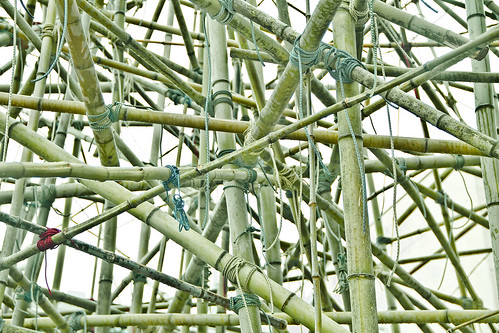
Tomorrow sees the opening of Doug and Mike Starn's Big Bambú installation on the roof of the Metropolitan Museum of Art. According to the museum's web page the installation is:
"a growing and changing sculpture―a vast network of 5,000 interlocking 30- and 40-foot-long fresh-cut bamboo poles, lashed together with 50 miles of nylon rope. It will continue to be constructed throughout the duration of the exhibition. The first phase of the structure―measuring about 100 feet long, 50 feet wide, and 30 feet high―will be completed by opening day, April 27. Subsequently, the artists and rock climbers will build up the eastern portion of the sculpture to an elevation of 50 feet. By summer, the western portion of the sculpture will be about 40 feet high. An internal footpath artery system will grow along with the structure, facilitating its progress. The evolving state of the work will be documented by the artists in photographs and videos."The Starn brothers installed Big Bambú in their Beacon, NY studio starting in late 2008.Check out their web page for information on that installation and this evolving artwork, set to be exhibited in Detroit next year as well.
(via The Architect's Newspaper)
Sunday, April 25, 2010
My weekly page update:
This week's dose features Two Projects in Poland by Medusa Group:
The featured past dose is Oslo School of Architecture in Oslo, Norway by Jarmund/Vigsnæs AS:
This week's book review is Re:Crafted: Interpretations of Craft in Contemporary Architecture and Interiors by Marc Kristal, and Transformer: Reuse, Renewal, and Renovation in Contemporary Architecture by Sandu Publishing:
Some unrelated links for your enjoyment:
architectureinberlin
A Berlin-based blog that recently played a large part in a (successful!) campaign to stop a developer from defacing John Hedjuk's IBA Building in that city. (added to sidebar under blogs::architecture)
Buildipedia.com
A "was started by a determined team of AEC industry professionals to share knowledge, promote best practices, and advance our understanding of the built environment." (added to sidebar under architectural links::online journals)
girlwonder
Blog of a "ph.d. candidate in the school of architecture at princeton university, writing a dissertation about history of interactivity in architecture" (added to sidebar under blogs::architecture)
 This past weekend held one of my favorite annual events, the Georgetown house tour. While photos are understandably not allowed of the tour, I was snap happy with plenty of inspiration around me! I always associate Georgetown with gas lanterns, I especially loved the contrast between this white painted stone and black metalwork seen above. I noticed a lot of houses (not on the tour) were for sale, a sad testament of the times.
  Many of the homes featured this year held unexpected surprises: be it ultra modernity or amazingly grand spaces behind sedate exteriors. The lineup was superb and varied. Don't miss the tour next year, it never disappoints and supports a great cause.
Beyond no.2 - Values and Symptoms edited by Pedro Gadanho
SUN Architecture, 2009
Paperback, 160 pages
The second issue of Beyond, a twice-yearly "bookazine dedicated to new, experimental forms of architectural and urban writing ... in which an extended network of young and upcoming European architectural writers are given the freedom to survey the outline of themes and things to come," is built around the theme Values and Symptoms. Editor Pedro Gadanho asks, "in the face of permanent crisis, what are the symptoms and values that are leading the reshaping of cities and everyday life?" In the slim volume are fifteen responses to the theme, one of which is an excerpt from Douglas Coupland's upcoming Generation A. Its inclusion is perhaps an attempt at a wider readership but more likely an example of where these experimental forms of writing should find influence: fiction.
Architecture fiction is a tiny subset of writing around architecture, a recent trend that is gaining traction as more architects, critics and other writers venture into the hard-to-define realm, something of course evident in this bookazine's existence. It's a term that appears to have started with Wired's Bruce Sterling, who dabbled in some architecture fiction. In many ways it is similar to science fiction, in a preference for speculating on future constructions, but with a focus on those constructions and their potential over the people, relationships, internal states, and other more psychological aspects of fiction. Witness how the fiction in the pages of the second Beyond -- not all of the essays are fiction -- like a short story by FAT's Sam Jacobs built around the Kennedy assassination, shies away from incorporating dialogue or first-person narratives, instead opting for third-person, external perspective. This is not always the case, but something I noticed recurrently, indicative as much of the experimental nature of the writing as the refusal to adopt a traditional fiction structure.
So do the format and contributions to Beyond make it a more appropriate format for exploration than, say, traditional avenues like architectural criticism, monographs, or other writings? Adopting a general embrace of urban/architectural fiction, the results can only veer from these other avenues, meaning that they are appropriate for paving new ways in thinking about architecture, space and the city. But this shouldn't be confused with innovation on par with technology or its incorporation into architectural production. How architecture is affected by the ideas conveyed in Beyond's essays is more vague than how new software may change form in architecture, for example. The variety and openness is refreshing, like a poetic mish-mash where architecture is the underlies it all.
US: CA: UK:
This is a reminder that I will be participating in a panel discussion on the "design press" tomorrow (Monday) evening. Details are below. If any readers attend please say hi!
The Changing State of the Design Press: Now What?When: 6:00 PM - 8:00 PM MONDAY, APRIL 26
Where: At The Center
There’s no question that the platforms for architectural dialogue are in flux. While some design publications are shrinking or even disappearing, other media outlets are using technology to broaden their reach. Design critics and journalists can use web sites, blogs, e-newsletters, and other forms of communication to talk about anything, from practice to technology. The mainstream press is even increasing its design-related reportage, supported by growing interest in such topics as sustainability, innovation, and urban planning. How do we navigate our current media landscape? To prepare for what’s now and what’s next, Oculus editor Kristen Richards will moderate a panel of editors from top publications who will discuss ongoing shifts in the design media and readership; how these changes are influencing the type and content of traditional print publications; the rise of new publications and new audiences; and the influence of blogs and on-line magazines.
Moderator:
Kristen Richards, editor, Oculus and www.ArchNewsNow.comPanelists:
Julie V. Iovine, Executive Editor, Architects Newspaper
Michael Sorkin, Principal, Michael Sorkin Studio, writer/editor/design critic
John Hill, A Daily Dose of Architecture
Robert Ivy, Editor-in-Chief, Architectural RecordOrganized by: AIA NY Marketing & PR Committee and the Oculus Committee
Sponsored by: Hausman LLC
Saturday, April 24, 2010
Here are some photos of the Car Park and Terminus Hoenheim North in Strasbourg, France by Zaha Hadid, 2001. Photographs are by Numstead who shot these on a trip after getting married last summer. Belated congratulations to Nathan Umstead and his wife!


To contribute your Flickr images for consideration, just:
:: Join and add photos to the archidose pool, and/or
:: Tag your photos archidose
 I hope everyone has a great weekend! Picture taken in Bucks County last week. MORE concrete!!
Friday, April 23, 2010
 Canadian architects Blouin Tardif Architecture have designed a home in Mont-Saint-Hilaire, Quebec. to find out more...

Last night I attended a panel discussion at the Museum of the City of New York about stormwater management, held around the exhibition of winners in the Minds in the Gutter competition I posted about in January. Now I'll admit that the management of stormwater -- the runoff from roofs, backyards and streets -- is not the most exciting topic, but the panelists* did a bang-up job of putting the issue front and center in the debate about how to make New York City greener. (Hence the timing with Earth Day.) I've never been a big fan of lecture and discussion write-ups, so I'll just highlight a few key points that were made.
- Most of New York City's stormwater is diverted into combined sewers (combined with the water from indoor plumbing) contributing to the once-a-week CSO (combined sewer overflow) events where the water the system cannot handle is dumped into harbors. This fact alone hinders competition organizer S.W.I.M.'s goal of being able to swim in NYC's waterways. The basic idea is to keep the stormwater out of the combined sewers, a very agreeable proposition but one hard to implement.
- When looking at stormwater management in terms of gray and green -- gray is the hard, engineering approach and green is the soft, sustainable approach -- both need to work together. Green solutions are too site-specific to have a widespread immediate effect and gray ones are what got us to this problem in the first place, so finding more gray fixes to the gray problems will not work.
- While the design competition only looks at public ways, the streets and sidewalks and open spaces that make up 1/3 of the city's land, one needs to think of storwmater management in terms of sewersheds, a la watersheds. If all of the winners' designs were implemented they would only provide an incomplete solution. Roofs and backyards also need to part of the solution, pointing to the need for a cultural shift (a mild one is perceived) where property owners are aware of their role and take steps towards a remediation of the problem...ideally with the help of the city/state with tax breaks and similar incentives.
- Keep an eye on the Hunters Point South development, as well as Atlantic Yards and Columbia University's Manhattanville expansion. In particular the first will be a pilot for the Department of Transportation's implementation of stormwater capturing via porous streets, a solution held up by issues of engineering and maintenance. Since Hunters Point South's streets will be new the city can implement these new techniques rather than having to rip up old streets before they know the techniques work and can be maintained.

Visit Urban Omnibus for a two-part post on Minds on the Gutter, which includes information on the winners.
*Deborah Marton, moderator, Executive Director of Design Trust for Public Space; Nette Compton, MIG juror, Senior Project Manager for Design at NYC Department of Parks and Recreation and Design Trust Fellow for Designing Parks for the 21st Century; Ed Janoff, NYC Department of Transportation Office of Planning and Sustainability; Eric Rothstein, MIG exhibitor, eDesign Dynamics; Barbara E. Wilks, MIG exhibitor, W Architecture and Landscape Architecture; Kate Zidar, Stormwater Infrastructure Matters (S.W.I.M.) Coalition

 Henry Chapman Mercer completed the museum in 1915 to house his collection of pre-industrial tools and relics which were largely disposed of in the whirl of early 20th century technology. Many pieces were rescued from the trash or bought for pennies at auction. In essence, Mercer created a museum to show how life was lived in the 18th & 19th centuries before industrialization took over.
 Examples of Mercer's tilework are found throughout the museum. I loved this 2 story fireplace (above) in a sacred feeling space devoted to his hundreds of beloved stove plates.
 Why concrete? Besides the fact that it was fireproof (a great concern of the time period) it was incredibly inexpensive and able to be formed into any shape or form imaginable. Mercer developed many interesting concrete techniques in his experimentations in building that amaze to this day. Above - his signature high on the exterior walls.
 Admittedly, I came for the building. Can you blame me? Most of the interior is open to an incredible atrium, flooded with natural light and full to the brim with all nature of antique objects.
 Objects as diverse as a whaling boat hung from a railing (seen above on the right), baby cradles attached to the ceiling and pre-industrial tools in stalls surrounding the walkways educate the viewer in 'how did they used to do that?'.
 A view over the roof shows the extensive use of concrete. The very window frames were poured concrete which were built from forms molded on traditional wood windows. These were inexpensive, fireproof and low maintenance. There isn't a single piece of flamable material in the entire building except for the collections.
 Please visit and support this fantastic museum, heralded as a masterpiece from its opening. As a side note, one of the quirks that Mercer loved to include in his buildings were the pawprints of his beloved dogs. Rollo was around while building his 2 castles (Fonthill and this museum) and his prints are proudly displayed. One of many inventive and ingenius ideas to be found!
Visit the Mercer Museum website.

