Tuesday, May 11, 2010
In July last year I posted about The Manhattan Airport Foundation's absurd proposal to transform Central Park into an airport. Well, that's got nothing on William Zeckendorf's dream airport for New York City, published in the March 18, 1946 issue of Life Magazine.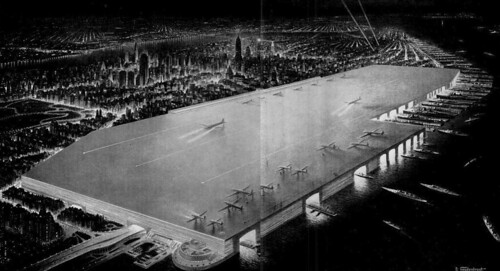
According to the magazine's text (found at Ptak Science Books where I discovered this gem), the airport would have covered 144 city blocks from 24th to 71st Streets and from Ninth Avenue to the Hudson River. (The view above is looking south.) That's approximately 990 acres 200-feet above the streets of Manhattan.
To quote Life, Zeckendorf thinks the $3 billion price tag "can be paid off by rental income within 55 years after the project is completed." Further, and quite optimistically, "although the Manhattan terminal is still in the drawing-board stage and has not yet had approval of New York officials, the planners expect that the increasing tide of air travel will make their idea a necessity." Considering I didn't notice an airport over my head the last time I walked west of Ninth Avenue in Hell's Kitchen, it looks like it wasn't as necessary as the planners imagined.
A handful of theatrical performances this Spring, all in New York City, incorporate architecture in various ways, be it thematic or set design. Below are some details on this synchronistic phenomenon.
Architecture of Dance
For the New York City Ballet's New Choreography and Music Festival, Santiago Calatrava has designed five sets for what's being called Architecture of Dance, showing now at Lincoln Center until June 27. Calatrava seems like a wise choice for this undertaking, given the inspiration he finds in the human body, the kineticism of some of his projects, and of course his name. The circles above, for example, move and overlap to activate the scenography and give the dancers something to respond to. Check out the video on the AOD mini-site for shots of this movement and explanation by Calatrava. The festival also commemorates the 50th anniversary of Lincoln Center.
Attila
For the Metropolitan Opera's recent production of Attila, Jacques Herzog & Pierre de Meuron created the sets and Miuccia Prada designed the costumes. The 19th-century play composed by Verdi "tells the story of civilization’s encounter with barbarism" across a backdrop of "destruction, rubble, lagoon, forest, darkness" rendered "all in a very naturalistic way" by the Swiss architects. The Architects Newspaper's blog has some photos of the floating rubble and vegetation.
The Bilbao Effect
The Bilbao Effect is the second part of a planned trilogy on contemporary architecture by Oren Safdie, the son of well-known architect Moshe Safdie. The younger's first play in the trilogy was 2003's Private Jokes, Public Places, which focused on gender roles in architecture and was set during an architecture student's project critique. The Bilbao Effect, opening for previews on March 12 at the Center for Architecture, "puts contemporary architecture on trial" after an architect's redevelopment project on Staten Island supposedly leads to a woman's suicide. Frank Gehry's presence in the Atlantic Yards project in Brooklyn is clearly a precedent for the play, especially since his Guggenheim in Spain led to the term of the play's title. The show runs until June 5.
The Glass House
The Glass House by June Finfer (directed by Evan Bergman) uses the Farnsworth House by Mies van der Rohe and Philip Johnson's Glass House as backgrounds for "the penetrating dramatic plot that entwines the epic conflict between artist and patron." Further, "Resonance Ensemble is presenting the play is in repertory with Ibsen's The Master Builder."
Theatre for One
Theatre For One from Theatre For One on Vimeo.
"Theatre for One is a portable performing arts space for one performer and one audience member, that turns public events into private acts, making each performance a singularly intimate exchange." Conceived by Christine Jones and designed by LOT-EK, the object will be in Times Square's Duffy Square for ten days, from May 14-23.
Theatre for One resembles a reconfigured "road box" used for theater and other productions. This is certainly in keeping with LOT-EK's preference for reusing prefab and modular constructions from outside architecture. Inside is red padded velvet, recalling the previous occupants of much of Times Square, peeping booths. This interior, which can be seen at BLDGBLOG, reminds me of a science-fiction film, like a cockpit from 2001 transplanted to Times Square.
Sunday, May 9, 2010
My weekly page update:
(**NOTE: The next update on my weekly page will be 2010.05.24.**)
This week's dose features Zamet Center in Rijeka, Croatia by 3LHD:
The featured past dose is Hotel Lone in Rovinj, Croatia by 3LHD:
This week's book review is HYBRIDS III: Residential Mixed-Use Buildings by Aurora Fernández Per:
Some unrelated links for your enjoyment:
Building for Life
"The UK's "standard for well-designed homes and neighborhoods." Be sure to check out the case studies.
Floornature Itineraries
"Virtual tours of contemporary architecture in Amsterdam, Barcelona, Paris and other cities." (added to sidebar under architectural links::guides)
archunderworld
A new blog, sometimes in Italian, sometimes in English (added to sidebar under blogs::architecture)
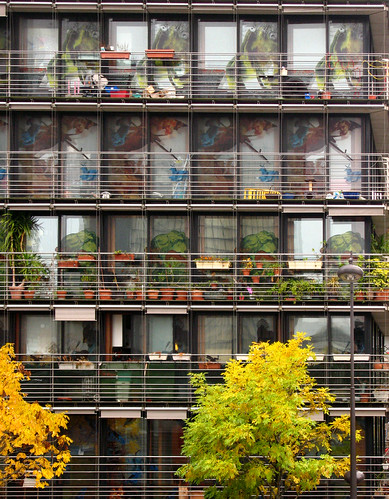
Residential building in the Massena quarter of Paris, France by Francis Soler, 1997.
To contribute your Flickr images for consideration, just:
:: Join and add photos to the archidose pool, and/or
:: Tag your photos archidose
Friday, May 7, 2010
About a block from the East River and the Pepsi sign in Long Island City is the Richard Meier Model Museum. Its presence is subtly discerned by a sign rendered in the familiar typographics and abundant white space that graces the architect's monographs, web page and everything else with the architect's stamp of approval.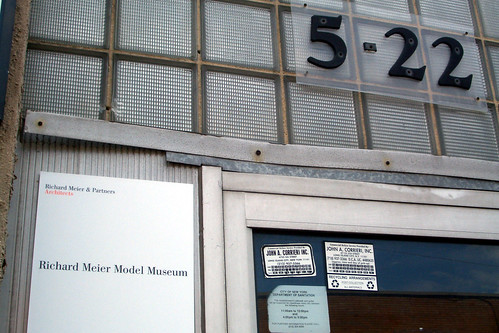
[the unassuming front door to the Richard Meier Model Museum]
Yesterday I was fortunate enough to attend a press tour of the museum with the architect himself, a day before it reopens to the public for its 2010 season. Below are some photographs I shot and some commentary on the 3,600sf space featuring works from the 1960s to the present.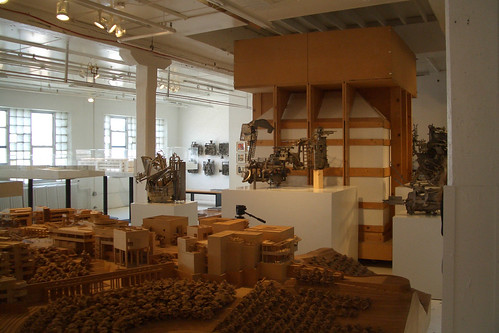
[view of the museum from the direction of the entrance]
Entering the third floor museum, the primarily wood models stand out in the all-white space. About half of the square footage is occupied by Getty Center models, from small-scale studies to a huge highly detailed, 16-piece model (foreground above) and an inhabitable gallery space used for studying daylighting (background above). The effect is certainly overwhelming, further elevating the significance of the master architect.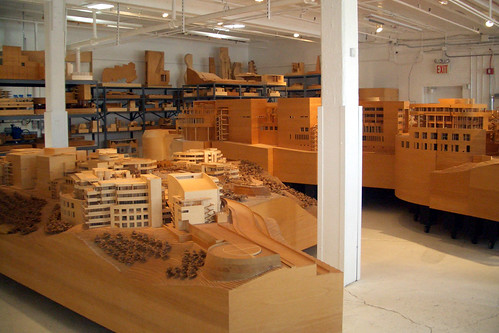
[looking the opposite direction of the previous photo]
What comes across in the myriad models is an unbelievable level of perfection and a consistency that jibes with Meier's buildings across his 40-odd year career. Study models seen earlier in a brief tour of Meier's west side office were anything but, resembling finished models more than works in progress. Precision and a refinement of space, light, material and detail predominate. My own tastes lean towards architects who vary their output in form and style according to the site and program at hand, but my admittedly inferior model-making skills make me appreciate the craft and patience they exhibit.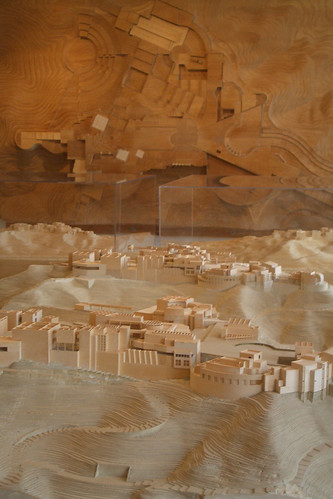
[early "studies" for the Getty Center]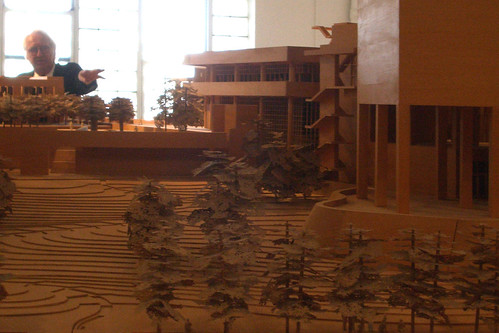
[Mr. Meier describing the Getty Center project]
Of the Getty Center models, perhaps my favorite was the one with a scale somewhere between the "studies" and the large-scale model loomed over by Meier above. Below is a detail of a quite big and highly detailed one-piece model that had to be craned into the museum through a now-covered skylight. I seem to recall the model being 16' long! I like it because it gives a much better sense of the overall project than the others, which are either too small to get into the particulars of each building, or too large to be absorbed at once. This one really conveys the scale and grandeur of the 15-year-long project.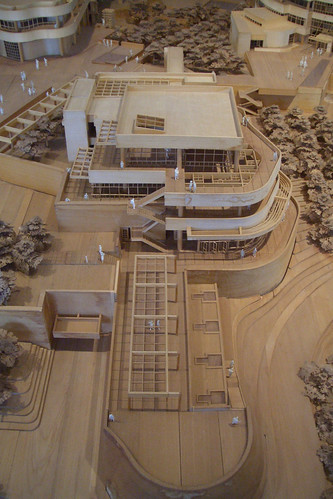
[another Getty Center model]
While the Getty is represented by a double-digit number of models, only one exists for the World Trade Center proposal Meier developed with Peter Eisenman, Charles Gwathmey and Steven Holl.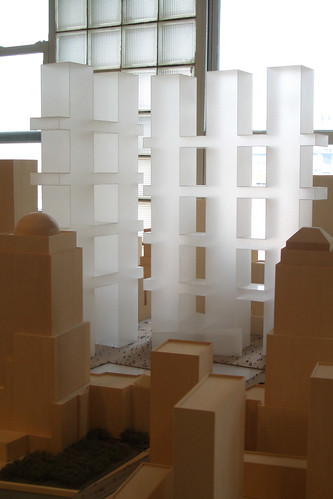
[WTC proposal model]
As most know the relatively diagrammatic design did not make it to the final round, but Meier holds high regard for the proposal and what it embodies, particularly in terms of how voids represent memory.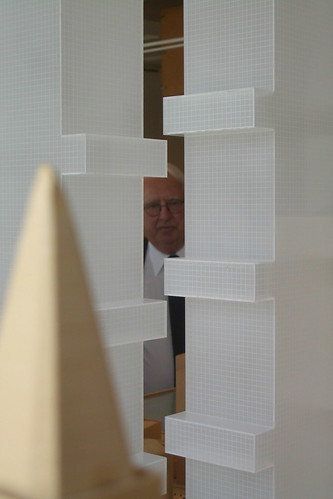
[Meier in the void between the two towers]
Lastly are the steel sculptures that Meier has created in his free time, messy assemblages compared to his crisp, precise, white buildings. An outlet from the rigor of his practice?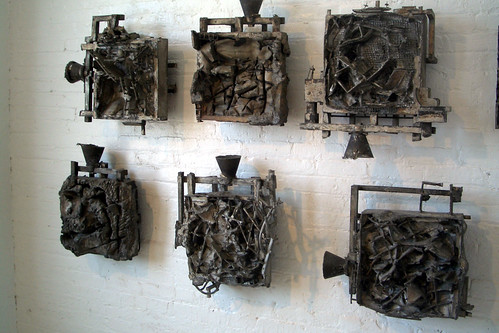
[Meier's artwork adorns the walls]
Previously I "mashed up" some of Meier's freestanding pieces with photos of his buildings to illustrate the discrepancy. In the model musuem, a real mash-up occurs in the juxtaposition between the crafted models and still crafted but uniquely different steel sculptures.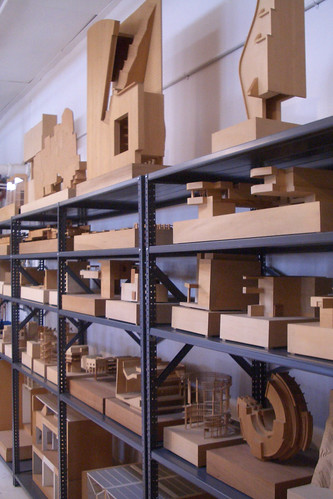
[models galore]
Those interested in visiting the Richard Meier Model Museum -- open on Fridays until August 27 -- should call his office at 212-967-6060.
 The interiors of Fonthill are probably even more fascinating than the exterior; they were the driving force behind the architecture afterall! Above you see some of the remaining color in one of the bathrooms. Originally the house was filled with many bright and pastel colors (some might say garish). Mercer was a collector of many things, including prints, which are displayed everywhere he could find wallspace including over the sink!
 Tiles by the Moravian Tile works are found everywhere - floors, ceilings and fireplaces. Mercer used the house as his laboratory and tile museum, bringing potential clients to see different examples and even allowing them to stay overnight. I especially love these tiles set into concrete on this chimney breast; Mercer was inspired by 16th century Italian fabric in this instance. Notice the Wedgwood Portland vase on the upper left-hand shelf.
 In Mercer's private study, you can see how much the room was used. The leather on the sofa is worn OUT, which I love to see. Books line this room (as elsewhere) as do ancient pottery examples sourced from all over the world. The wood paneling was reclaimed from many sources, much of it from old doors; Mercer was nothing if not resourceful. This was one of the few rooms with wood flooring and where he would have spent much of his time; amazing views out the huge corner windows of the garden.
 The Columbus room was dedicated to the discovery of the New World and the tiles are all about this event. The tiles were set into the concrete formwork as the ceiling was being poured and were not applied afterwards; an innovative technique!
 The interior photographs are by Bjorn Wallander and were featured in the Sept. 2007 Martha Stewart Living magazine. Thanks to Kathy of Hearth and Hedgerow Ltd. for helping me gather some information. Check out her blog!
Thursday, May 6, 2010
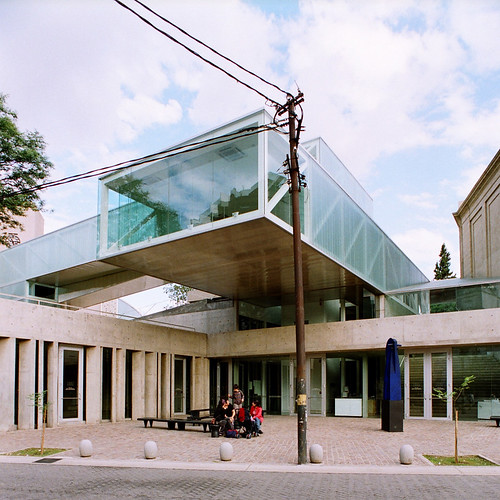
Museo Provincial de Bellas Artes Emilio Caraffa, Córdoba Capital, Provincia de Córdoba, Argentina, originally uploaded by Federico Kulekdjian Fotografía.
Museo Provincial de Bellas Artes Emilio Caraffa in Córdoba Capital, Provincia de Córdoba, Argentina by Gramatica / Morini / Pasini / Urtubey Arquitectos, 2008.
To contribute your Flickr images for consideration, just:
:: Join and add photos to the archidose pool, and/or
:: Tag your photos archidose
 "More than 1000 great buildings from around the world and across history are listed below and illustrated on this web site and the Great Buildings Collection on CD-ROM, with photographic images, architectural drawings, discussion, bibliography, architect info, and live 3D walkthrough computer models."

 "We developed architectural forms that open through a series of organic flowing ribbons in a gesture of invitation, outreach and optimism, gathering the energy of the site into a major new public square. These layered glass and stainless steel planes are carefully composed to orientate and join the forms and internal volumes of the new building to significant landscape elements. The central atrium and internal gathering space is directed out between the two largest ribbons to connect with the natural landscape of the Auckland Domain, the northern figural ‘head’ is turned to look directly towards the Harbour and Rangitoto Island while terminating the axial vista of Wynyard Street." to find out more...
Wednesday, May 5, 2010
 Down an allee of ancient trees in Bucks County lies a ancient looking fairytale arts and crafts castle. This is the last thing you would expect to find in rural Pennsylvania, more fitted to the English countryside perhaps.
 More bizarre however is the material: concrete. Much like his museum, the Mercer, Henry Chapman Mercer built his own house between 1908 and 1912 out of this versatile material. While not quite to the extent as the museum, the house still incorporates concrete in the roofs (mostly covered in clay tiles made at the adjacent factory), dormers, chimneys, floors, walls and ceilings.
  Light was Mercer's key concern. Over 200 windows were incorporated into the facade in all shapes and sizes: Most are operable. As a testament to the design, even on cloudy days candlelight (or electric lights) are barely needed unlike the castle's European precedents.
 The house is truly quirky and enchanting. As it's the brainchild of Mercer, I would expect him to be a fascinating character as well: I'd love to pick his brain over a meal!
 Color is greatly incorporated into the building, unlike his later museum. While most of the interior pastel colors have faded over the years (another testament to the amount of light received) the window sills and doors are still vibrant shades of red and yellow.
 Mercer employed a surprisingly small number of employees in the building of his structures, whom he would personally train. He was a great employer in that he loved that they all took pride in their work and treated them well. Many are commemorated throughout the space, such as the work horse (literally) Lucy; He created a wind vane in her honor.
 The house is truely an amalgamation of styles and shapes - a working dictionary of forms. From one angle it may appear one way and then after turning the corner, the structure takes on an entirely different shape.
 Here you can see some examples of the concrete windows - inoperable of course. They were created from the moulds of operable antique wood windows, with the glass set into wet concrete. An unusual technique and one which works well obviously as the windows are original to the structure.
 Mercer was lucky to have passed away at his beloved home in 1930. His housekeepers lived in the house till their deaths many years later at which point it became a museum. Of course, stories are passed around about the castle being haunted, but I had no such experience as I did at the nearby Phillips Mill!
 Don't miss the interiors tomorrow!
Tuesday, May 4, 2010
Architizer, as many readers here know, is a website that "empowers architecture" and architects by connecting them with each other and a broader audience. At its root is a Facebook/LinkedIn-esque system where individuals are given a face alongside the usual projects found on the site and elsewhere. But do the firms have faces, beyond the individuals? Well, ass a way to kick start my "firm faces" feature in gear again, I browsed the site's Firms tab to see how many firms actually put faces on their logo. Below is a sampling from a quick perusal of the first 50 or so pages.
Needless to say, most firms choose to represent themselves through typography, custom illustrations and the occasional building photograph. "Identity" these days is associated with things (custom logos) that are more stable than the people (architects) that actually do the work. No surprise that logos are more common, or that faces occur in smaller firms, but I like the range of those brave enough to give faces to the firms.
 This past weekend, I attended a wedding at the Woodlawn Plantation. While not as well-known as its neighbor, Mt. Vernon, it certainly is a more beautiful building (in my opinion!). If Federal style architecture isn't your thing, the Pope-Leighey house by Frank Lloyd Wright is also on the grounds. Something for everyone!
 The 126 acres that currently make up Woodlawn were originally part of George Washington's estate, Mt. Vernon and were deeded in a 2,000 acre parcel to his nephew, Major Lawrence Lewis. Lewis had Dr. William Thornton, the architect of the U.S. Capitol design this house which was completed in 1805.
 The beautiful grounds are often the site of elegant weddings and it's the perfect setting for any party.
 Cocktail hour was held in this side yard which has a fountain that frogs love to visit in the evening! Rib-bit!
 While I can't offer a peak inside, this look into the window at night gives you an idea of the amount of restoration that went into this 200 year + old house. The last private owner, Senator Underwood of Alabama, sold the house in 1952 to become part of the National Trust for Historic Preservation.
 Keep in mind the weather in Northern Virginia is far from hospitable much of the year and it can get HOT and MUGGY. I don't know how I survived the 93 degree heat and high humidity let alone past residents in their heavy clothing and without our modern convienences.
 My favorite part of the house is the bell mounted to the side of one chimney; To call everyone in for meal times perhaps? Now thats some technology (but I'd rather have A.C.)!
 Visit this lesser known cousin of Mt. Vernon if you're in the DC area rather than fight the crowds at Mt. Vernon. Better yet -visit both!
Monday, May 3, 2010
My weekly page update:
This week's dose features The Danish Pavilion Expo 2010 in Shanghai, China by BIG:
The featured past dose is Mountain Dwellings in Copenhagen, Denmark by Bjarke Ingels Group:
This week's book review is Shanghai Transforming edited by Iker Gil:
Some unrelated links for your enjoyment:
Architects Talk
"Architecture videos and quality conversation." (added to sidebar under architectural links::audio/video)
Architecture of Dance
A new festival of the New York City Ballet with sets by Santiago Calatrava.
DesignIntelligence
Blog of the well-known publisher. (added to sidebar under blogs::architecture)
The Lefthander
Architecture category of news aggregator. (added to sidebar under blogs::aggregate)
Materials Lab
Very thorough database of materials by the UTA School of Architecture. (added to sidebar under architectural links::education)
